
2017-2021 DE used HEV/PHEV
$24,000First-generation NZ-new DE Hybrid and PHEV. Typical 60,000 to 130,000 km on clean-history examples.
Weekly
$109.67
Monthly
$475.23
A compact crossover financed across hybrid, plug-in hybrid and battery-electric lines in New Zealand.
Last reviewed: 24 April 2026
Your estimated repayment
Weekly
$165/week
We are not a finance company. Indicative only. Not a quote or offer of credit. Actual rates, fees, and repayments depend on your circumstances and the lender's decision.
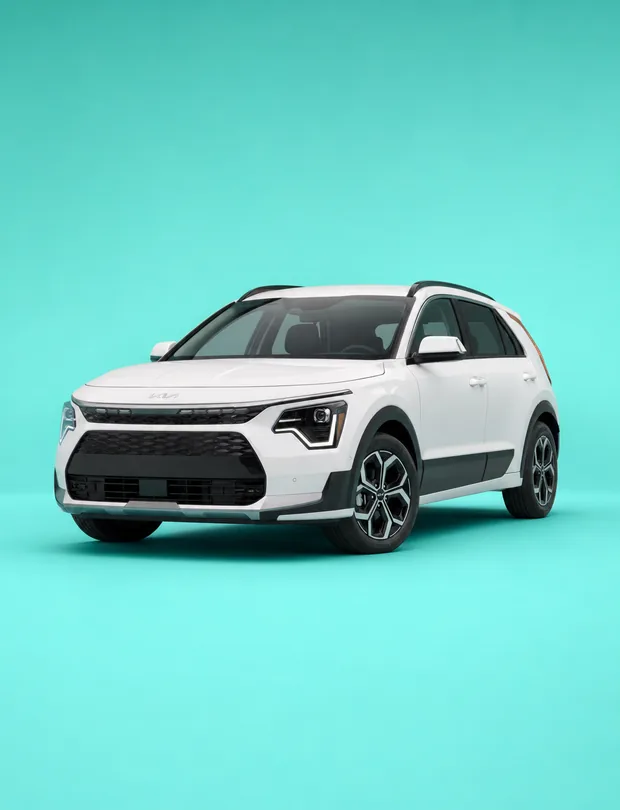 Kia Niro finance calculator Not a lender. Not a broker.
 The Kia Niro is a compact crossover built from the ground up around electrified drivetrains, with three parallel lines on the NZ market: a self-charging Niro HEV, a plug-in Niro PHEV, and a battery-electric Niro EV. The first-generation DE launched in New Zealand in 2017 and ran until the second-generation SG2 landed in 2022 with a visually distinct split C-pillar and larger 64.8 kWh battery on the EV. Financed Niro amounts typically fall in the $25,000 to $80,000 band, which spans used DE Hybrid stock through to new SG2 EV long-range trims. The Niro is commonly cross-shopped against the Hyundai Kona, Toyota Corolla Cross, BYD Atto 3 and MG ZS, and its three-drivetrain spread means a broker quote often sits across multiple lender product tiers, including the dedicated EV or green-loan tier that several NZ lenders apply to the Niro EV.
Calculate repaymentsIndicative only. Not a quote or offer of credit.
Year by year
Typical NZ market prices and the weekly cost of financing each. All figures assume 7% over 5 years with no deposit. Indicative only; open the full calculator to pre-set your own rate and term.
2017-2021 DE used HEV/PHEV
$24,000First-generation NZ-new DE Hybrid and PHEV. Typical 60,000 to 130,000 km on clean-history examples.
Weekly
$109.67
Monthly
$475.23
2019-2021 DE used EV
$32,000First-generation DE EV with 39.2 kWh and 64 kWh battery options. Ex-lease stock from 2022 onward is the common listing.
Weekly
$146.22
Monthly
$633.64
2022-2024 SG2 used
$44,000Second-generation SG2 across HEV, PHEV and EV. 11.1 kWh PHEV battery, 64.8 kWh EV battery. Hybrid is the volume seller.
Weekly
$201.06
Monthly
$871.25
2025+ new SG2
$58,000Full NZ-new SG2 lineup with refreshed trim levels. EV Earth and GT-Line sit at the top of the range.
Weekly
$265.03
Monthly
$1,148.47
Who this suits
Financing notes
At a $36,000 used 2023 Niro HEV on a five-year term at 8.5% indicative, the weekly repayment sits at roughly $171, or about $741 a month. A near-new SG2 EV near $65,000 on the same settings lifts the weekly to around $308. Several NZ lenders price the Niro EV on a dedicated EV or green-loan tier; the PHEV is occasionally offered on the same tier. RUC applies to the Niro EV at $76 per 1,000 km since April 2024, with a lower plug-in rate on the PHEV.
Model-specific questions
On a $36,000 used 2023 Niro HEV at 8.5% indicative over five years with no deposit, the repayment works out to roughly $171 a week. A used 2022 Niro EV Earth near $52,000 on an EV-tier indicative rate of 7.75% lands around $242 a week. A new SG2 EV at $65,000 on the same EV tier runs at approximately $302 a week. Actual rates depend on the lender's credit assessment.
Several NZ lenders apply an EV or green-loan tier to battery-electric vehicles. On a Niro EV, qualification is typically straightforward because the vehicle is clearly a pure EV on the Carjam record. Lenders usually confirm drivetrain, VIN and valuation as part of the application; the EV tier isn't automatic and is widely checked for during the broker quote, particularly on used DE stock.
It varies by lender. Some NZ lenders extend a green or low-emission tier to plug-in hybrids including the Niro PHEV, which typically sits between the standard rate and the full EV tier. Others class plug-ins as standard hybrids for finance-pricing purposes. The Niro HEV self-charging hybrid almost always attracts a standard used-car rate rather than any dedicated green tier.
RUC has applied to pure-electric light vehicles, including the Niro EV, since 1 April 2024 at the light-EV rate of $76 per 1,000 km. Plug-in hybrids including the Niro PHEV pay a lower plug-in RUC rate. On 14,000 km a year, Niro EV RUC adds roughly $1,060; home-charged electricity still typically runs materially below petrol on indicative NZ running-cost trends.
Five years is the common default on a Niro HEV or PHEV. On a Niro EV, a three or four-year term is more commonly chosen because used-EV residual curves have historically been steeper than comparable petrol or hybrid small-SUVs on indicative NZ market observation. A seven-year term lowers the weekly but adds material total interest across the loan.
The loan stays in place because the obligation is to the lender, not to Kia. Kia NZ's battery warranty on NZ-new Niro EV is 7 years or 150,000 km, which typically covers most of a standard five-year loan term. On Japanese or Korean imports the factory battery warranty usually doesn't transfer, and mechanical breakdown cover for high-voltage components is commonly considered.
The Niro HEV sits around $4,000 to $8,000 above comparable NZ-new petrol small-crossover stock in 2026. The hybrid returns around 4.2 L/100km against roughly 6.5 L/100km on class-average petrol in typical NZ driving. Over a five-year loan the fuel saving typically closes the gap above 14,000 km a year; under 10,000 km the petrol case stays stronger on indicative NZ running-cost trends.
Yes, on essentially the same terms as a dealer purchase. A Carjam report typically verifies the VIN, odometer, and any existing secured interest on the PPSR; the seller must clear any listed security at settlement. On a private-sale Niro EV, a verified battery state-of-health report from a Kia dealer or EV specialist is commonly requested by the lender before funds are released.
Our finance partner compares multiple NZ lenders. Calculator inputs travel through to the application, and the partner returns a formal estimate after the lender's credit assessment.
Disclaimer
A car loan runs for years, and the repayment comes out of the same pay that covers everything else. This site exists to show you that weekly number before you sign anything. The payment that catches people out is the one that's fine on a good week and tight on a bad one.
Carfinance.org.nz receives a commission from Simplify when a visitor applies through this site and their application is approved. We refer every visitor to the same partner because they compare multiple New Zealand lenders on the applicant's behalf, so the referral is not driven by a sponsored deal. Simplify sets its own terms and fees and discloses them directly; anything you agree to happens on their side, not ours. Every figure shown on this site is a modelled estimate based on the inputs entered; the actual rate, fees, and repayments are set by the lender after assessing the applicant's circumstances and its own credit decision. Carfinance.org.nz is a calculator and information tool. We are not a lender, not a broker, and not a registered financial adviser. Any decision about whether a specific loan suits a specific situation is best made after talking with the lender, and for amounts that materially affect the household, with a registered financial adviser.
Connecting you with a trusted NZ finance partner
One moment while we hand you over securely. Nothing was collected on our side.