
Asking the lender explicitly whether a green-loan or low-emissions discount applies is what usually happens before signing. The discount rarely triggers automatically; a supporting document and an explicit rate request are typically the trigger. A 6 percentage point discount on a $35,000 loan over 5 years saves roughly $3,000 of interest, making the inquiry well worth the effort.
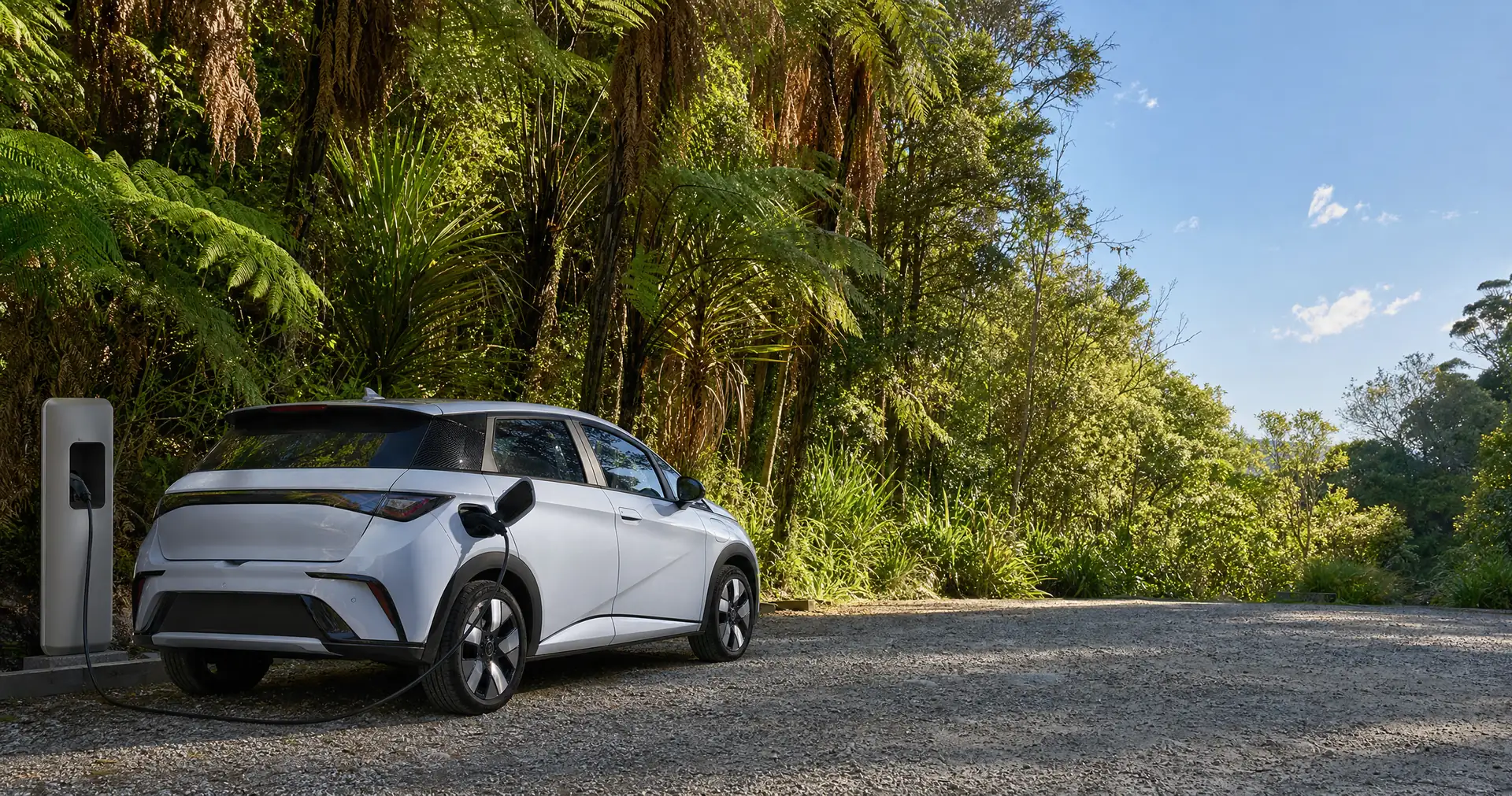
Electric car loan.
Financing a BEV or PHEV in the post-discount era.
Your estimated repayment
Weekly
$158/week
$316 /fortnight $685 /month
$35,000
$0
6.50% p.a.
5 years
Apply for a formal estimate
We are not a finance company. Indicative only. Not a quote or offer of credit. Actual rates, fees, and repayments depend on your circumstances and the lender's decision.
Overview
The short version.
An electric vehicle loan is a car loan specifically for a battery-electric (BEV) or plug-in hybrid (PHEV) vehicle, and in New Zealand the economics have changed twice in the last three years.
The Clean Car Discount rebate was scrapped at the end of 2023, and from April 2024 BEVs started paying Road User Charges (currently $76 per 1,000 km). Both changes moved the break-even maths for EV ownership, and by extension the finance case.
The loan itself still runs like any secured car loan, but several mainstream NZ lenders now offer green-loan pricing (typically 1 to 2 percentage points below their standard car-loan rate) for low-emissions vehicles, which can more than offset the extra paperwork of confirming the car qualifies.
Who this suits
This loan type is built for:
- Commuters in Auckland, Wellington, or Christchurch driving 20,000 km a year or more, where the fuel saving against a petrol equivalent is material.
- Households with off-street parking and the ability to install a 7 kW wall charger, which changes overnight charging from useful to effectively free on off-peak plans.
- Buyers shopping used BEVs in the $25,000 to $45,000 band (Leaf gen 2, MG4, BYD Dolphin, pre-facelift Tesla Model 3) where depreciation has already taken the hit.
- Landlords, fleet managers, or rideshare drivers where the per-km running cost advantage compounds fast across a year of heavy use.
How it differs
How it differs from a standard car loan.
- Westpac publicises an EV or green-loan product with a meaningful discount (typically around 6 percentage points below its standard car-loan rate). The offer is specific to low-emissions vehicles and you generally have to ask for it, providing the WoF or NZTA record confirming the drivetrain.
- Battery state-of-health is a real underwriting consideration on used EVs. A 2016 Leaf with 8 of 12 bars will finance differently from a 2019 Leaf with 11, because the lender is lending against an asset whose useful life is partly determined by battery degradation.
- RUC became payable on BEVs from April 2024 at $76 per 1,000 km, which meaningfully changes the running-cost case against a hybrid or efficient petrol. Modelling total cost of ownership with RUC included before signing is the common pattern.
- Charging infrastructure affects the loan decision indirectly. Lenders don't ask about it, but if you can't charge at home is running a different vehicle economically, and the weekly-cost case for the loan weakens accordingly.
What you need
What the lender will ask for.
- Proof of income for the last 3 months (payslips or bank statements) as with any secured car loan.
- Vehicle details including VIN, odometer, and drivetrain confirmation. The drivetrain is what qualifies the loan for green pricing where a lender offers it.
- On used BEVs, a recent battery health report (Leaf Spy printout, manufacturer diagnostic, or dealer-supplied state-of-health percentage) is increasingly expected.
- NZ driver licence, 3 months of bank statements, and evidence of the regular commute or use case where the fuel-cost argument is being used for affordability.
- Full comprehensive insurance is usually a loan condition given the repair cost of battery packs after collision damage.
Tips from us
How to set yourself up for a good outcome.
On used BEVs, the battery-health report is widely treated in the same category as a pre-purchase mechanical inspection on a petrol car. A battery under 80% state-of-health materially changes both the useful range and the resale value, and no finance structuring fixes that.
Modelling the numbers with RUC included and a realistic off-peak charging rate (around 15 c/kWh) is the usual pattern. EV running-cost calculators built before April 2024 often omit RUC entirely and make the case look rosier than it actually is now.
On a PHEV rather than a BEV, confirming with the lender whether green-loan pricing applies is the common first step. Some programmes cover both; others are BEV-only. PHEVs also pay RUC from 2024 at a reduced PHEV rate (around $38 per 1,000 km), so the running-cost story is more nuanced than pure-EV marketing suggests.
Common questions
Electric car loan FAQ.
Do NZ lenders still offer a green-loan discount on electric vehicles?
Westpac publicises a dedicated EV or green-loan product with pricing typically around 6 percentage points below its standard car-loan rate. You generally have to request it and supply documentation confirming the drivetrain; the discount isn't automatic. Other mainstream lenders may offer green products, but the Westpac EV offering is the most widely publicised discount available.
How does RUC on electric vehicles change the financing decision?
Road User Charges applied to BEVs from April 2024 at $76 per 1,000 km, which adds roughly $1,140 a year to running costs for a 15,000 km driver. That narrows the gap against a hybrid or efficient petrol and is typically built into the affordability model before a loan term is committed.
Will a lender finance a used Nissan Leaf with reduced battery capacity?
Usually yes, but the terms reflect the battery condition. Many lenders now ask for a state-of-health reading, and a Leaf sitting at 8 of 12 bars or below may attract a shorter loan term or a slightly higher rate because the asset has a shorter remaining useful life than a petrol equivalent of the same model year.
Is it harder to get finance on a used import EV compared with an NZ-new EV?
It can be, for two reasons. Compliance history is thinner on a freshly imported vehicle, and battery diagnostic tools are not uniform across Japanese-spec and NZ-spec cars. Lenders also prefer an NZ-supplied warranty history. An NZ-new EV from a franchised dealer generally clears underwriting faster.
What term should I choose for an EV loan?
Three to five years is typical. Stretching beyond five on a used BEV is risky because battery degradation and rapid model-cycle changes (newer EVs arrive with materially more range each year) can leave you underwater on the loan before you have finished paying it off. Shorter is usually safer.
Does the Clean Car Discount still apply to new EV purchases?
No. The Clean Car Discount rebate was abolished at the end of 2023 and isn't returning under the current policy settings. Anyone modelling EV finance with the old rebate baked in is working from outdated numbers; the headline purchase price is now the full sticker price minus whatever dealer discount you negotiate.
You might also want
Keep exploring
Last reviewed: 23 April 2026
Ready to apply for car finance?
Our finance partner compares multiple NZ lenders, so one application is checked against a spread of them rather than a single book.