
2023-2024 used
$52,000Early NZ stock. 58 kWh V and 77 kWh V most common. Typically 20,000 to 50,000 km by 2026.
Weekly
$237.61
Monthly
$1,029.66
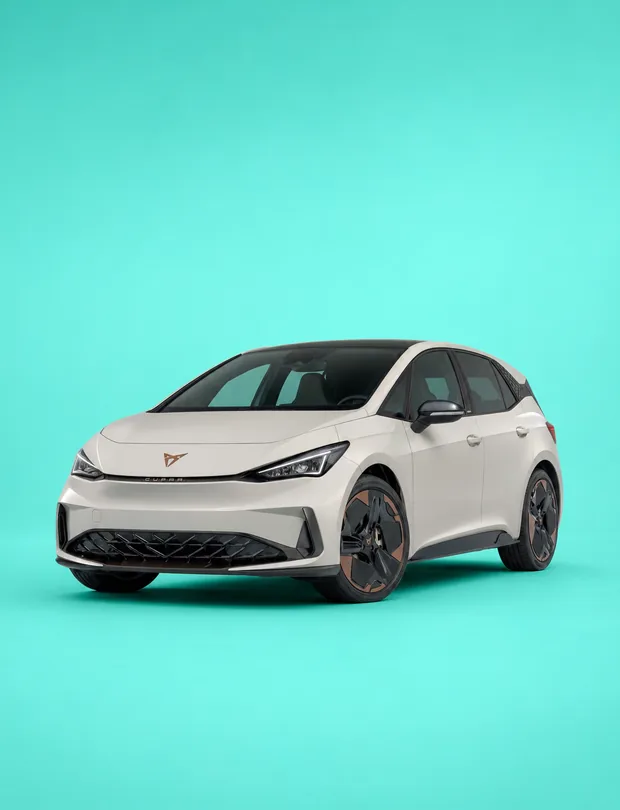
Cupra's full-electric hatch, sharing the MEB platform with Volkswagen ID.3 and Audi Q4 e-tron.
Last reviewed: 24 April 2026
Your estimated repayment
Weekly
$297/week
We are not a finance company. Indicative only. Not a quote or offer of credit. Actual rates, fees, and repayments depend on your circumstances and the lender's decision.
 Cupra Born finance calculator Not a lender. Not a broker.
 The Born is Cupra's full-electric hatch and the brand's first bespoke EV in New Zealand. It rides on the Volkswagen Group MEB platform shared with ID.3 and Audi Q4 e-tron, with a sportier exterior and interior treatment than the ID.3 donor car. NZ stock runs 58 kWh and 77 kWh rear-motor variants, with a performance-oriented VZ trim layered on top. All NZ Borns are NZ-new through European Motor Distributors, so every car arrives with factory warranty and a documented service path. Loan amounts typically sit in the $55,000 to $85,000 bracket. Lenders commonly apply the EV tier, subject to credit assessment, because the asset is low-emissions and the drivetrain carries extended factory coverage.
Calculate repaymentsIndicative only. Not a quote or offer of credit.
Year by year
Typical NZ market prices and the weekly cost of financing each. All figures assume 7% over 5 years with no deposit. Indicative only; open the full calculator to pre-set your own rate and term.
2023-2024 used
$52,000Early NZ stock. 58 kWh V and 77 kWh V most common. Typically 20,000 to 50,000 km by 2026.
Weekly
$237.61
Monthly
$1,029.66
2025 used
$62,000Mid-cycle update. Software refresh and expanded trim mix including VZ performance variant.
Weekly
$283.31
Monthly
$1,227.67
2025+ new 77 kWh
$75,000Current dealer stock. 77 kWh long-range trim the volume seller. Factory warranty full term.
Weekly
$342.71
Monthly
$1,485.09
Born VZ flagship
$85,000Performance trim, higher output rear motor. Priced at the top of the Born range.
Weekly
$388.41
Monthly
$1,683.10
Who this suits
Financing notes
At a $65,000 used 77 kWh Born on a five-year term at 7.5% indicative (EV tier), the weekly repayment lands at roughly $299, or about $1,297 a month. A new 77 kWh at $75,000 on the same settings lifts the weekly to around $345. A Born VZ at $85,000 runs around $391 a week on the same settings. RUC at the light-EV rate of $76 per 1,000 km has applied since 1 April 2024 and typically adds $910 a year at 12,000 km of annual distance, which is roughly $17.50 a week on top of the finance outgoing. Cupra NZ residual data is thinner than Volkswagen ID.3 because Born has been on sale here only since 2023; a 15 to 25% deposit is commonly observed as a hedge while that data matures.
Model-specific questions
On a $65,000 used 77 kWh Born at 7.5% indicative over five years with no deposit, the repayment works out to roughly $299 a week. A new 77 kWh at $75,000 on the same settings lands near $345 a week, and a Born VZ at $85,000 runs around $391. A 20% deposit on the $75,000 figure drops the weekly to around $276. These figures are illustrative only; actual rates depend on the lender's assessment.
On most mainstream NZ lenders, yes. The Born is NZ-new through European Motor Distributors with full factory battery warranty, which typically satisfies the EV-tier criteria. From what we see the EV tier sits meaningfully below the equivalent standard consumer rate at the same lender. A broker can confirm which panel lenders currently include Born inside the EV tier and which are still pricing it at a standard performance-vehicle rate.
Yes on 2023 onward cars with a verified EMD-dealer service history. Because Cupra and Volkswagen share the EMD distribution network and the MEB platform, Born service records typically carry comparable weight with NZ lenders. Cupra NZ residual data is thinner than ID.3 and materially thinner than EV6. Buyers who prioritise a sportier EV character often favour Born; buyers who prioritise the deepest NZ EV used-market liquidity often favour EV6 or ID.3.
All pure-electric Borns have been subject to RUC at the light-EV rate of $76 per 1,000 km since 1 April 2024. On 12,000 km a year, that adds around $910 annually, or roughly $17.50 a week on top of finance and insurance. RUC has become the second-largest running-cost line after insurance on an EV from what we see. An RUC balance transfers with the vehicle at sale and is commonly checked before settlement.
Home charging from a standard wall socket or a 7 kW wallbox is the commonly observed pattern for Born ownership in New Zealand and typically keeps the car topped up overnight. Without home charging, reliance on ChargeNet or hotel DC charging typically lifts the running-cost line by a few dollars a week on top of RUC. The Born's 77 kWh variant supports DC charging up to 170 kW, which matters less at home and more on longer trips.
Yes, on essentially the same terms as a dealer purchase. Because the Born has only been on sale since 2023, the private-sale market is shallow and most used stock still flows through franchised EMD dealers. A Carjam report typically verifies the VIN, odometer, and any existing secured interest on the PPSR before settlement. A pre-purchase inspection from an EV-experienced workshop at $200 to $350 has a reputation as worth the cost.
Deposits in the 15 to 25% range are typical on Born finance because the buy-in sits in the $55,000 to $85,000 bracket and Cupra NZ residual data is still maturing. A 20% deposit on a $75,000 77 kWh reduces the weekly by around $70 and trims total interest materially over five years. Trade-in equity from a Golf, Polo, or an older petrol hatch commonly supplies the deposit, and some buyers roll proceeds from an existing EV with remaining warranty.
On indicative NZ used-market trends, early 2023 to 2024 Borns have shown a first-two-year curve broadly in line with Volkswagen ID.3 and softer than Kia EV6, which can put a zero-deposit five-year loan underwater through year one and into year two. A 15 to 25% deposit and a four or five-year term are the commonly observed defences. EV residual patterns across the NZ market have been evolving, and Cupra-specific data is still forming through 2026.
You might also want
Our finance partner compares multiple NZ lenders. Calculator inputs travel through to the application, and the partner returns a formal estimate after the lender's credit assessment.
Disclaimer
A car loan runs for years, and the repayment comes out of the same pay that covers everything else. This site exists to show you that weekly number before you sign anything. The payment that catches people out is the one that's fine on a good week and tight on a bad one.
Carfinance.org.nz receives a commission from Simplify when a visitor applies through this site and their application is approved. We refer every visitor to the same partner because they compare multiple New Zealand lenders on the applicant's behalf, so the referral is not driven by a sponsored deal. Simplify sets its own terms and fees and discloses them directly; anything you agree to happens on their side, not ours. Every figure shown on this site is a modelled estimate based on the inputs entered; the actual rate, fees, and repayments are set by the lender after assessing the applicant's circumstances and its own credit decision. Carfinance.org.nz is a calculator and information tool. We are not a lender, not a broker, and not a registered financial adviser. Any decision about whether a specific loan suits a specific situation is best made after talking with the lender, and for amounts that materially affect the household, with a registered financial adviser.
Connecting you with a trusted NZ finance partner
One moment while we hand you over securely. Nothing was collected on our side.