
2013-2015 used (W176 pre-facelift)
$19,000First NZ-new W176. A180 and A200 most common. Typical 110,000 to 170,000 km. Dual-clutch 7G-DCT service history and turbocharger condition dominate the pre-purchase picture.
Weekly
$86.82
Monthly
$376.22
The entry premium hatch on New Zealand Mercedes-Benz finance applications.
Last reviewed: 24 April 2026
Your estimated repayment
Weekly
$146/week
We are not a finance company. Indicative only. Not a quote or offer of credit. Actual rates, fees, and repayments depend on your circumstances and the lender's decision.
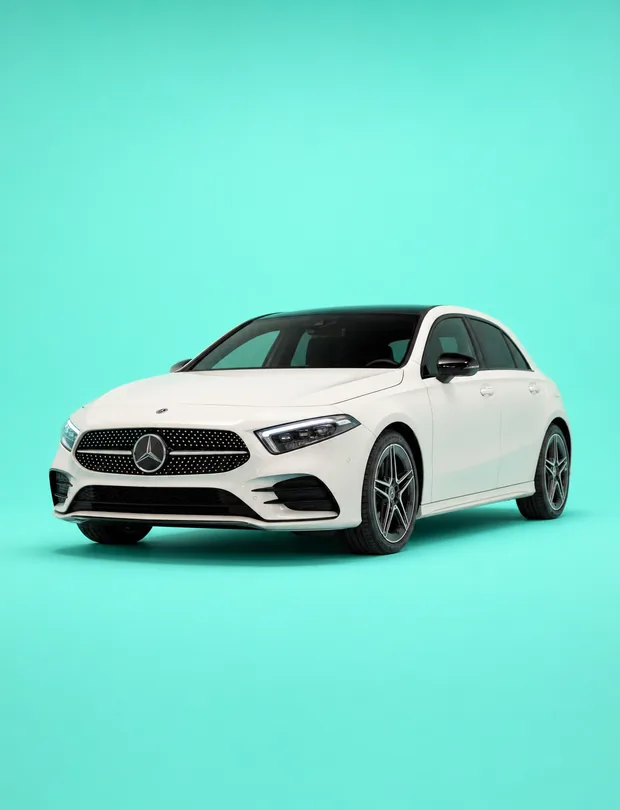 Mercedes-Benz A-Class finance calculator Not a lender. Not a broker.
 The A-Class is the smallest passenger Mercedes-Benz sold in New Zealand and the accessible entry point into the three-pointed-star badge. The W176 generation (2013 to 2018) opened the front-wheel-drive platform era and remains the dominant used-market body, while the current W177 (2019 onward) moved the cabin to the MBUX architecture and widened the AMG performance path through A35 and the flagship A45 S. It cross-shops against the BMW 1 Series and Audi A3 inside the German premium-hatch set, and informally against the Honda Civic Type R and Volkswagen Golf R at the AMG end. Used-market pricing starts around $22,000 on high-km W176 A180 examples and runs to roughly $95,000 on a current AMG A45 S, which keeps the A-Class across a wide slice of the premium finance book.
Calculate repaymentsIndicative only. Not a quote or offer of credit.
Year by year
Typical NZ market prices and the weekly cost of financing each. All figures assume 7% over 5 years with no deposit. Indicative only; open the full calculator to pre-set your own rate and term.
2013-2015 used (W176 pre-facelift)
$19,000First NZ-new W176. A180 and A200 most common. Typical 110,000 to 170,000 km. Dual-clutch 7G-DCT service history and turbocharger condition dominate the pre-purchase picture.
Weekly
$86.82
Monthly
$376.22
2016-2018 used (W176 LCI)
$27,000Facelifted W176. A180, A200, and A250 widely available. AMG A45 from this era commanding a meaningful premium over standard variants.
Weekly
$123.38
Monthly
$534.63
2019-2022 used (W177)
$42,000Current-gen W177 with MBUX infotainment and widescreen dash. A180, A200, and A250 4MATIC feed the bulk of the pool; AMG A35 clearing in the late half of this era.
Weekly
$191.92
Monthly
$831.65
2023+ new/nearly-new (W177 LCI)
$72,000Facelifted W177. A200, AMG A35 4MATIC, and AMG A45 S 4MATIC+ dominate current Mercedes-Benz NZ dealer stock. AMG Line packaging near-universal on new orders.
Weekly
$329.00
Monthly
$1,425.69
Who this suits
Financing notes
At $32,000 on a late-model W177 A200 across a five-year term at an indicative 8%, weekly repayments land around $149, or roughly $648 a month. A new A200 near $72,000 on the same settings lifts the weekly to about $336. An AMG A35 around $85,000 sits near $397 a week on matched settings, and an AMG A45 S near $95,000 runs near $443. Mercedes-Benz Financial Services NZ is a captive lender and runs subvented rate campaigns on specific new A-Class stock periodically, particularly at quarter-end, which are worth benchmarking directly against an independent broker quote. Agility balloon structures appear on A-Class deals less often than on GLC and E-Class because the loan size is smaller and the cash-flow benefit of deferring principal is narrower.
Model-specific questions
On a $32,000 late-model W177 A200 at 8% indicative over five years with no deposit, the weekly sits at roughly $149. A new A200 near $72,000 on the same settings lands near $336 a week. An AMG A35 around $85,000 runs near $397, and an AMG A45 S near $95,000 lands around $443. A 15% deposit on the $72,000 car drops the weekly to around $286. These figures are illustrative only; actual rates depend on the lender's credit assessment and any active Mercedes-Benz Financial Services campaign.
The W176 has a reputation as one of the more accessible entry points into Mercedes-Benz ownership because used-market pricing overlaps with well-specified mainstream hatches at matched mileage. Running costs sit above a mainstream-hatch equivalent: scheduled servicing through a Mercedes-Benz NZ dealer runs meaningfully higher, the 7G-DCT dual-clutch has a defined fluid-service interval, and out-of-warranty repair exposure is the key variable. An independent Mercedes-Benz specialist pre-purchase inspection is commonly treated as non-optional on W176 examples past 120,000 km, particularly on A250 and AMG A45 variants where the turbocharger and transmission carry the highest repair cost if issues surface.
The AMG A-Class variants carry a purchase premium of roughly $20,000 to $30,000 over an equivalent-age A200 depending on generation and spec. The rate applied by most NZ lenders is identical on the two on the same applicant profile, so the weekly repayment difference tracks the loan size closely. Running costs diverge materially: premium 98 fuel is typically specified, tyre spend on the AMG 19-inch or 20-inch wheels runs well above the A200 on 18-inch, and insurance on an A45 S sits a tier above the A200, particularly in Auckland. Buyers who prioritise drivetrain performance often favour A35 or A45 S; buyers who prioritise running-cost efficiency often favour A200.
Mercedes-Benz Financial Services NZ is a captive lender with its own loan book and runs subvented rate campaigns on specific new A-Class stock periodically, particularly at quarter-end or against end-of-model-year inventory. When a campaign is live the dealer rate is often hard to beat through an independent broker because the rate is partly funded by Mercedes-Benz rather than by the lender's standard cost of funds. When no campaign is active, the dealer default rate is a standard premium-secured rate and a broker quote typically becomes the useful comparison. Getting the specific campaign terms in writing (rate, deposit, term, and any Agility balloon component) is the common way to evaluate the offer properly.
Loan amounts on matched-spec W177 A200, F40 118i, and 8Y A3 30 TFSI track closely in the used market, and the rate applied by most NZ lenders is similar across the three German premium hatches on the same applicant profile. The captive-finance story differs: Mercedes-Benz Financial Services, BMW Financial Services, and Audi Finance each run their own campaign cycles, so the cheapest path on new stock varies month to month rather than clustering around one brand. Buyers who prioritise cabin design and MBUX infotainment commonly favour A-Class; buyers who prioritise drive characteristics commonly cross-shop 1 Series and A3 alongside.
Yes, on W176 and earlier W169 examples in particular, through most NZ premium-car lenders once entry compliance is complete. A rate premium of 0.5 to 1.5 percentage points over an equivalent NZ-new A-Class is typical, and the maximum term is often capped at four years rather than five to seven because residual-value data on Japanese-market trim combinations is thinner. A clean odometer verification report and a Mercedes-Benz specialist pre-purchase inspection are commonly treated as non-optional on imports, particularly on A45 variants from the previous generation where the four-cylinder turbocharger and dual-clutch transmission carry the most expensive out-of-warranty repair risk.
Five years is the typical default on both new and late-model used A-Class loans. Three and four-year terms are common on used W176 examples under $30,000 because total interest stays modest and the balance pays down ahead of the depreciation curve. Seven-year terms are offered on new W177 A-Class by some lenders but lift total interest meaningfully and, on the premium-hatch depreciation profile, make negative equity in the middle years more likely if the car is traded early. On our calculator, a $70,000 loan at 8% indicative over seven years adds more than $9,000 in total interest compared with the same loan over five years.
Negative equity can occur on an A-Class where a zero-deposit loan is taken on a new car, or where the loan term stretches beyond the typical ownership cycle. Indicative NZ used-market trends suggest premium compact hatches depreciate at a rate close to the segment average, which means a five-year loan on a new W177 A200 with a modest deposit tracks reasonably close to the market price through the term. If the car is traded before the balance clears, the shortfall is commonly paid in cash or rolled into the next loan; rolling negative equity forward tends to be treated as a pattern to manage carefully because it compounds across ownership cycles.
You might also want
Our finance partner compares multiple NZ lenders. Calculator inputs travel through to the application, and the partner returns a formal estimate after the lender's credit assessment.
Disclaimer
A car loan runs for years, and the repayment comes out of the same pay that covers everything else. This site exists to show you that weekly number before you sign anything. The payment that catches people out is the one that's fine on a good week and tight on a bad one.
Carfinance.org.nz receives a commission from Simplify when a visitor applies through this site and their application is approved. We refer every visitor to the same partner because they compare multiple New Zealand lenders on the applicant's behalf, so the referral is not driven by a sponsored deal. Simplify sets its own terms and fees and discloses them directly; anything you agree to happens on their side, not ours. Every figure shown on this site is a modelled estimate based on the inputs entered; the actual rate, fees, and repayments are set by the lender after assessing the applicant's circumstances and its own credit decision. Carfinance.org.nz is a calculator and information tool. We are not a lender, not a broker, and not a registered financial adviser. Any decision about whether a specific loan suits a specific situation is best made after talking with the lender, and for amounts that materially affect the household, with a registered financial adviser.
Connecting you with a trusted NZ finance partner
One moment while we hand you over securely. Nothing was collected on our side.