
2013-2015 used
$7,500Earliest NZ-new Mirage plus Japanese imports. Typically 130,000+ km with basic infotainment and no reversing camera.
Weekly
$34.27
Monthly
$148.51
Commonly financed as a budget first-car small hatch in New Zealand.
Last reviewed: 24 April 2026
Your estimated repayment
Weekly
$50/week
We are not a finance company. Indicative only. Not a quote or offer of credit. Actual rates, fees, and repayments depend on your circumstances and the lender's decision.
 Mitsubishi Mirage finance calculator Not a lender. Not a broker.
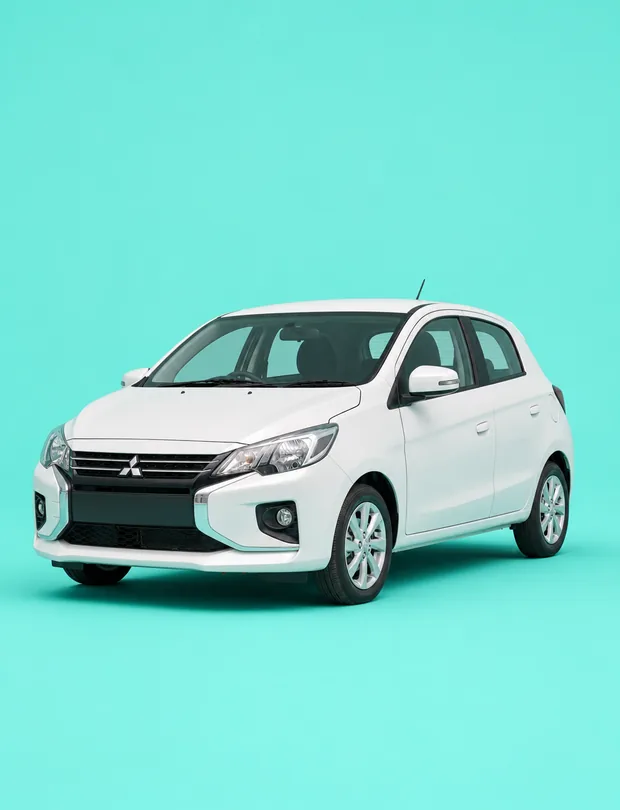
 The Mitsubishi Mirage is a sub-Swift budget small hatch that sold in New Zealand as new stock from 2013 until the nameplate wound down around 2023. The car runs a 1.2 three-cylinder petrol with a CVT automatic on most NZ examples, and is built on a light chassis that prioritises fuel economy and low running cost over performance or refinement. Mirage is commonly cross-shopped with the Suzuki Alto, Kia Picanto, base Toyota Yaris, and earlier Nissan Micra at similar loan sizes. With NZ-new stock discontinued, the used market now dominates Mirage finance, and loan amounts typically fall in the $8,000 to $18,000 bracket. That small ticket makes Mirage one of the more common thin-credit-file first-car applications on the NZ market, though lender minimum-loan policies can apply at the very bottom of the price range.
Calculate repaymentsIndicative only. Not a quote or offer of credit.
Year by year
Typical NZ market prices and the weekly cost of financing each. All figures assume 7% over 5 years with no deposit. Indicative only; open the full calculator to pre-set your own rate and term.
2013-2015 used
$7,500Earliest NZ-new Mirage plus Japanese imports. Typically 130,000+ km with basic infotainment and no reversing camera.
Weekly
$34.27
Monthly
$148.51
2016-2019 used
$11,000First facelift. LS and XLS trims widely listed. CVT auto dominant; manual is rare on the used market.
Weekly
$50.26
Monthly
$217.81
2020-2023 used
$14,500Late-production NZ-new Mirage before nameplate discontinuation. Often ex-rental or ex-fleet with full service history.
Weekly
$66.26
Monthly
$287.12
2024+ used-only
$16,000Nearly-new run-out stock where dealers still hold it. No new NZ stock produced beyond 2023; used market dominates.
Weekly
$73.11
Monthly
$316.82
Who this suits
Financing notes
At an $11,000 used Mirage on a four-year term at 10% indicative, the weekly repayment sits at roughly $64, or about $279 a month. A newer $16,000 Mirage on a five-year term at the same rate lifts the weekly to around $78. First-car buyers with a thin credit file often see indicative rates toward the upper end of the small-car band, and some lenders set a minimum loan size of $5,000 to $10,000 which can exclude the cheapest Mirage listings. A guarantor arrangement tends to improve approval odds.
Model-specific questions
On an $11,000 used Mirage at 10% indicative over four years with no deposit, the repayment works out to roughly $64 a week. A $16,000 later-model Mirage at the same rate over five years lands near $78 a week. A 10% deposit on the same $16,000 Mirage drops the weekly to around $70. These figures are illustrative only; actual rates depend on the lender's assessment.
Yes. The Mirage is one of the more commonly financed first cars on the NZ market because the loan size stays small and the insurance band is modest. Lenders typically assess first-car applications on income stability, existing debt, and time in role; a 10 to 20% deposit or a parent guarantor generally lift approval odds and shave the indicative rate compared to a zero-deposit, thin-file application.
Sometimes, but some NZ lenders set a minimum loan size of $5,000 to $10,000 which can exclude the cheapest Mirage listings. Where the loan size is below the lender's minimum, a personal loan outside the secured-car-loan product can be an alternative, though the indicative rate is commonly higher. A broker can canvas lenders active at that loan size.
Lender fixed costs per loan application are similar regardless of loan size, so the indicative rate on a $9,000 Mirage loan is commonly higher than the rate on a $30,000 Yaris Cross loan. The absolute dollar interest stays small because the balance is small, but the percentage rate looks less flattering. Shorter terms mitigate the total interest impact.
Most NZ lenders fund compliant imported Mirage examples once entry compliance is certified and the first NZ WoF is issued. Indicative rates on imports typically sit 0.5 to 1.5 percentage points above equivalent NZ-new Mirage from what we see. Maximum term is often capped at four years rather than five, and a Carjam report with odometer verification has a reputation as essential.
Three and four-year terms are common on Mirage because the loan size is small and total interest stays modest. Five years is offered on later-model Mirage to keep the weekly low, though on a $15,000 loan at 10% indicative the total-interest gap between three and five years is roughly $1,700 on our calculator. Shorter terms are typically preferred where the budget allows.
Mirage depreciation has been relatively shallow in dollar terms on the NZ used market on indicative trends, simply because the car starts at a low price and has limited room to fall. Year-one negative equity is uncommon on a modestly deposited four-year loan, typically, which makes the Mirage one of the more forgiving small cars to finance for a first-time buyer.
You might also want
Our finance partner compares multiple NZ lenders. Calculator inputs travel through to the application, and the partner returns a formal estimate after the lender's credit assessment.
Disclaimer
A car loan runs for years, and the repayment comes out of the same pay that covers everything else. This site exists to show you that weekly number before you sign anything. The payment that catches people out is the one that's fine on a good week and tight on a bad one.
Carfinance.org.nz receives a commission from Simplify when a visitor applies through this site and their application is approved. We refer every visitor to the same partner because they compare multiple New Zealand lenders on the applicant's behalf, so the referral is not driven by a sponsored deal. Simplify sets its own terms and fees and discloses them directly; anything you agree to happens on their side, not ours. Every figure shown on this site is a modelled estimate based on the inputs entered; the actual rate, fees, and repayments are set by the lender after assessing the applicant's circumstances and its own credit decision. Carfinance.org.nz is a calculator and information tool. We are not a lender, not a broker, and not a registered financial adviser. Any decision about whether a specific loan suits a specific situation is best made after talking with the lender, and for amounts that materially affect the household, with a registered financial adviser.
Connecting you with a trusted NZ finance partner
One moment while we hand you over securely. Nothing was collected on our side.