
2013-2016 used
$12,000Kuga-era Escape. Often 2.0L petrol or EcoBoost. Typical 150,000+ km.
Weekly
$54.83
Monthly
$237.61
The passenger-side family SUV in the Ford range.
Last reviewed: 23 April 2026
Your estimated repayment
Weekly
$101/week
We are not a finance company. Indicative only. Not a quote or offer of credit. Actual rates, fees, and repayments depend on your circumstances and the lender's decision.
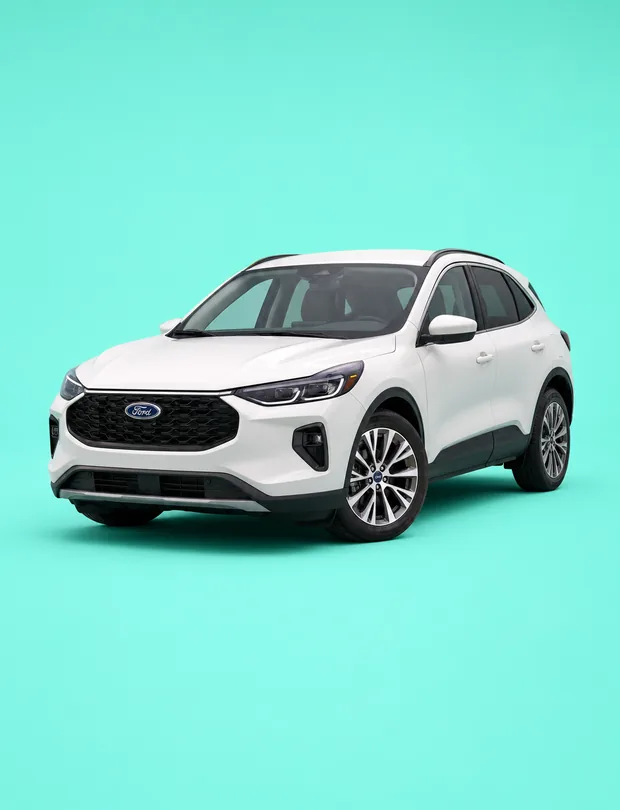 Ford Escape finance calculator Not a lender. Not a broker.
 The Escape is Ford's mainstream mid-size family SUV in NZ and sits well behind the Ranger on volume, but it remains a common second-car pick for Ranger households and a reasonable standalone family option. Petrol drivetrains, a plug-in hybrid variant on newer examples, and an approachable used-market price point make the finance application a straightforward passenger-SUV file rather than a commercial one. Lender residual-value data is thinner than on the Ranger, so terms tend to stay shorter.
Calculate repaymentsIndicative only. Not a quote or offer of credit.
Year by year
Typical NZ market prices and the weekly cost of financing each. All figures assume 7% over 5 years with no deposit. Indicative only; open the full calculator to pre-set your own rate and term.
2013-2016 used
$12,000Kuga-era Escape. Often 2.0L petrol or EcoBoost. Typical 150,000+ km.
Weekly
$54.83
Monthly
$237.61
2017-2019 used
$18,000ZG generation facelift. Mix of 1.5L EcoBoost petrol and 2.0L diesel variants.
Weekly
$82.25
Monthly
$356.42
2020-2022 used
$26,000Current-gen introduction. 2.0L EcoBoost petrol standard; PHEV available from 2021.
Weekly
$118.81
Monthly
$514.83
2023+ new/nearly-new
$42,000Current-gen refresh. Petrol and PHEV the common pick.
Weekly
$191.92
Monthly
$831.65
Who this suits
Financing notes
At $22,000 across a 5-year term at 7.5% indicative, the weekly repayment sits at about $102, or $441 a month. A 4-year term drops total interest meaningfully while keeping the weekly manageable on a household budget. Escape resale is softer than Ranger resale, so a shorter term generally reduce the risk of negative equity in the back half of the loan.
Model-specific questions
Some lenders include qualifying plug-in hybrids in their "efficient vehicle" loan products at a discount below standard rates, and the Escape PHEV usually qualifies. Availability varies by lender and changes over time; a broker typically confirms whether a green-rate applies at application. Fully battery-electric products commonly attract a larger discount than PHEVs.
All three finance through the same lender product set at broadly similar indicative rates. The Escape has thinner used-market volume and slightly softer residuals than the CX-5 or RAV4, so lenders are marginally more conservative on loan-to-value and term length. Buyers who prioritise lower buy-in often favour Escape; buyers who prioritise resale often favour CX-5 or RAV4.
On an $18,000 used 2018 Escape at 8% indicative over four years with no deposit, the weekly repayment sits at roughly $105. A 2023 Escape PHEV near $42,000 on a 5-year term at 7% indicative runs at around $192 a week. Actual rates are confirmed by the lender after credit assessment; these figures are illustrative only.
A 10 to 20% deposit ($2,000 to $4,000 on a $20,000 used Escape, $4,000 to $8,000 on a new PHEV) is the usual range. Typically a deposit typically lowers the indicative rate and reduces negative-equity exposure in the first 12 months. Zero-deposit loans are available on late-model Escape examples for borrowers with steady income and a clean credit file.
Four years is the usual shape as the default on used Escape because resale data is thinner than on mainstream Japanese rivals. Five years is common on a new Escape or Escape PHEV. Seven-year terms are available but grow total interest materially and extend the negative-equity window, which matters more on a softer-residual SUV like Escape.
Yes, on essentially the same terms as a dealer purchase. An indicative broker rate sourced before negotiating is the common first step. A Carjam report typically verifies the VIN, odometer, and any existing secured interest on the PPSR; the seller must clear any listed security at settlement. A pre-purchase inspection at $150 to $250 tends to be treated as worth the cost on older Kuga-era examples.
Our finance partner compares multiple NZ lenders. Calculator inputs travel through to the application, and the partner returns a formal estimate after the lender's credit assessment.
Disclaimer
A car loan runs for years, and the repayment comes out of the same pay that covers everything else. This site exists to show you that weekly number before you sign anything. The payment that catches people out is the one that's fine on a good week and tight on a bad one.
Carfinance.org.nz receives a commission from Simplify when a visitor applies through this site and their application is approved. We refer every visitor to the same partner because they compare multiple New Zealand lenders on the applicant's behalf, so the referral is not driven by a sponsored deal. Simplify sets its own terms and fees and discloses them directly; anything you agree to happens on their side, not ours. Every figure shown on this site is a modelled estimate based on the inputs entered; the actual rate, fees, and repayments are set by the lender after assessing the applicant's circumstances and its own credit decision. Carfinance.org.nz is a calculator and information tool. We are not a lender, not a broker, and not a registered financial adviser. Any decision about whether a specific loan suits a specific situation is best made after talking with the lender, and for amounts that materially affect the household, with a registered financial adviser.
Connecting you with a trusted NZ finance partner
One moment while we hand you over securely. Nothing was collected on our side.