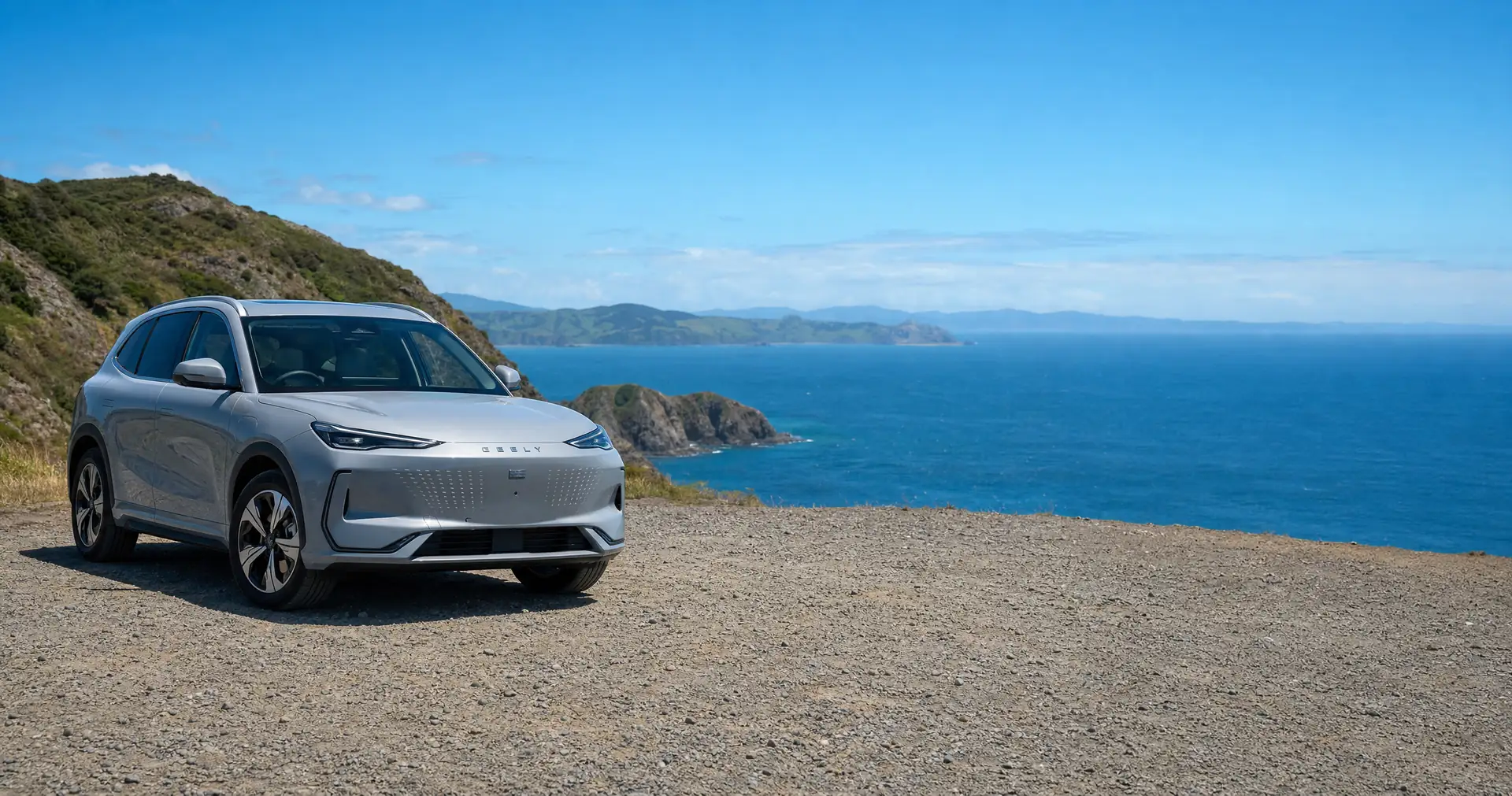
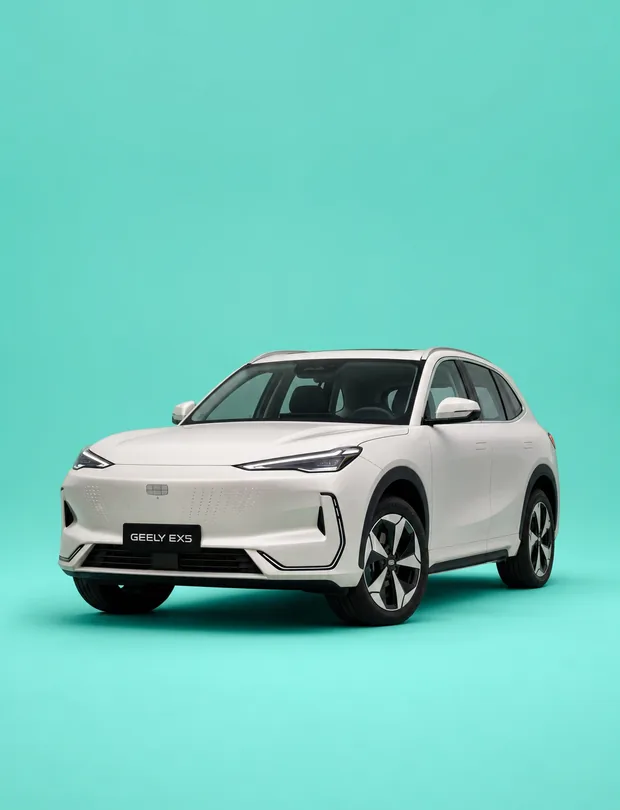
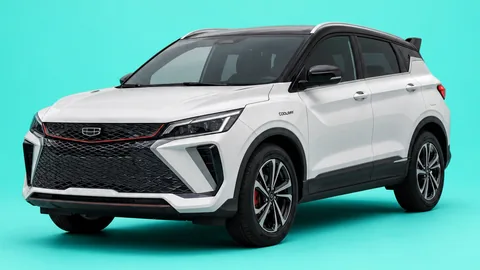
Geely entered the New Zealand market as a standalone brand in 2025, separate from sister brands Volvo and Polestar that also sit within the Geely Auto Group corporate family. The NZ dealer network is concentrated in Auckland with a handful of other centres and was still expanding in 2026. Geely doesn't operate a captive finance arm in New Zealand, so every Geely loan is arranged through an independent broker or bank.
At most mainstream NZ secured-car lenders, yes, on NZ-new EX5 applications. The EV tier typically sits 0.5 to 1.5 percentage points below the standard secured-car rate. A handful of lenders apply age, km, or minimum-loan criteria that can affect eligibility, so confirm the EX5 specifically by name when the broker quotes because criteria on new Chinese EV nameplates can evolve quickly.
Geely Auto Group owns Volvo Cars and Polestar alongside the Geely nameplate, but the three brands sell as separate marques with separate product engineering, separate dealer networks, and separate residual-value data. A Geely EX5 or Starray EM-i is a Geely in the NZ used market, not a Volvo in disguise. Do not price or finance on the assumption that group overlap carries residuals across.
10 to 20% is the common range on a new NZ-new Geely, in line with mainstream secured-car finance. On a $46,000 Starray EM-i that's $4,600 to $9,200. On a $52,000 EX5, $5,200 to $10,400. Some lenders lean toward the higher end on longer terms because Geely residual data in NZ is still forming, and a larger deposit usually also sharpens the offered rate.
Four years is the sensible default on NZ-new Geely stock in 2026 because NZ residual-value data is still genuinely thin. Five years is defensible on the EX5 with a 20%-plus deposit, supported by the EV loan tier rate. Six or seven-year terms are rarely prudent on Geely because the dealer network is still expanding and the used-market supply is extremely thin, which leaves the residual picture uncertain.
Most NZ lenders will fund compliant parallel-imported Geely vehicles provided they have cleared NZ entry compliance, but expect a rate 0.5 to 1.5 percentage points above an NZ-new equivalent. Geely NZ factory warranty doesn't apply to parallel imports, software update and parts support may be narrower, and lenders price that residual uncertainty in. Terms of three years are the common shape on a parallel import.
Geely's 2026 NZ dealer network is concentrated in Auckland with developing coverage in other centres, which is thinner than MG, Haval, or GWM. For buyers outside the main Geely dealer catchment, warranty visits and complex repairs can mean a longer trip. Lender residual treatment reflects this indirectly because used-market resale is stronger in cities with active Geely dealer support.
Servicing on Geely (EX5, Starray EM-i, Riddara RD6) runs broadly in line with other Chinese-brand NZ nameplates on a 15,000 km schedule through the Geely NZ dealer network. Insurance typically sits $150 to $400 a year above a Toyota or Mazda equivalent because repair and parts-supply data on Geely is still building with NZ insurers. The gap narrows each year as local volume grows.
If your trade-in is worth more than the balance still owing (positive equity), the new dealer pays out the old loan and any surplus applies to the next purchase. If the trade-in falls short (negative equity), the shortfall rolls into your new loan. Because Geely NZ residual data is still forming, trade-in offers are typically conservative, so negative equity on a long term is more likely than on Toyota or Mazda.
For a $52,000 NZ-new EX5 on a five-year EV-tier loan around 7.5%, finance costs total roughly $62,700 (principal plus interest). Add insurance (around $9,000), servicing (around $3,200), tyres (around $2,000), home charging (around $3,200), and RUC (around $5,300) for an indicative all-in of roughly $85,000 over five years. Figures depend on distance driven and electricity plan. Starray EM-i PHEV totals will differ because RUC is lower ($532 at 14,000 km vs $1,064) but petrol fuel adds $1,000 to $1,500 per year depending on charging habits.