
2021-2022 used
$38,000Early NZ-new Deliver 9 stock. 2.0L turbo-diesel common. Used supply thin outside main centres; LVV-certified conversions beginning to reach the used market.
Weekly
$173.64
Monthly
$752.45
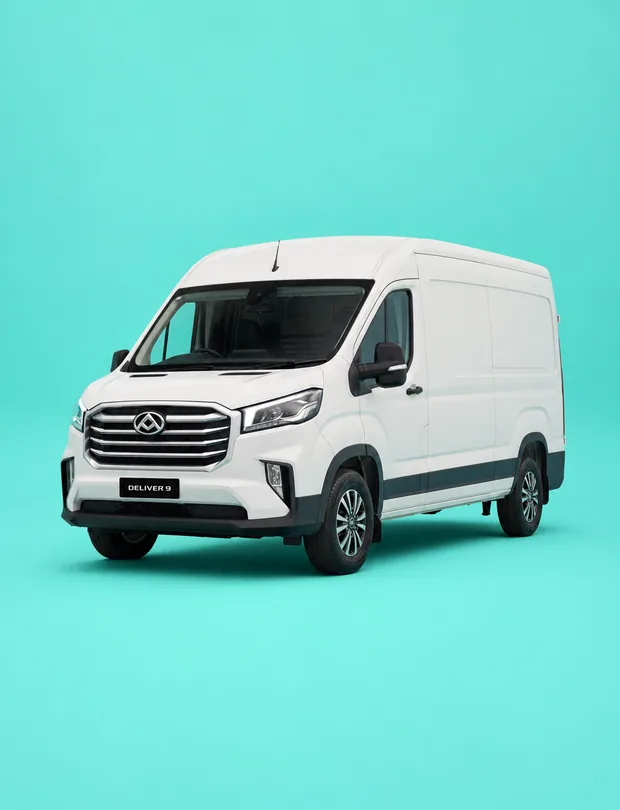
The large cargo van in the LDV NZ range, sold as 2.0L turbo-diesel and eDeliver 9 EV.
Last reviewed: 24 April 2026
Your estimated repayment
Weekly
$251/week
We are not a finance company. Indicative only. Not a quote or offer of credit. Actual rates, fees, and repayments depend on your circumstances and the lender's decision.
 LDV Deliver 9 finance calculator Not a lender. Not a broker.
 The LDV Deliver 9 is the brand's large commercial van in New Zealand and the main reason LDV appears on courier, trade, and conversion loan books alongside the T60 ute. Finance applications typically sit between $45,000 on used MWB diesel examples and $85,000 on a new eDeliver 9 EV or LWB high-roof diesel. The Deliver 9 cross-shops against the Ford Transit, Mercedes-Benz Sprinter, Volkswagen Crafter, and Hyundai iLoad at roughly 60 to 75% of a comparable Sprinter or Crafter price at like spec. Inchcape-distributed NZ-new supply through the LDV NZ dealer network has firmed meaningfully since 2022, which has supported lender residual underwriting on used examples. Almost every Deliver 9 on NZ roads is financed through a commercial structure (chattel mortgage, operating lease, or finance lease) rather than a consumer loan.
Calculate repaymentsIndicative only. Not a quote or offer of credit.
Year by year
Typical NZ market prices and the weekly cost of financing each. All figures assume 7% over 5 years with no deposit. Indicative only; open the full calculator to pre-set your own rate and term.
2021-2022 used
$38,000Early NZ-new Deliver 9 stock. 2.0L turbo-diesel common. Used supply thin outside main centres; LVV-certified conversions beginning to reach the used market.
Weekly
$173.64
Monthly
$752.45
2023-2024 used
$52,000Broader NZ-new supply. Interior and driver-assist updates across MWB and LWB. eDeliver 9 EV introduced in late 2023 on select variants.
Weekly
$237.61
Monthly
$1,029.66
2025+ new
$70,000Current generation. 2.0L turbo-diesel MWB and LWB the volume commercial picks; eDeliver 9 EV in growing urban-fleet use. $55k-$85k new depending on wheelbase, roof height, and drivetrain.
Weekly
$319.87
Monthly
$1,386.08
Who this suits
Financing notes
At $55,000 across a 5-year chattel mortgage at roughly 8.5% indicative, the weekly repayment sits at around $261 or about $1,128 a month. Under a chattel mortgage the weekly is the same, but the GST on a $55,000 GST-inclusive purchase (around $7,174) is typically claimable in the next GST return where the business is GST-registered and the Deliver 9 is used primarily for taxable activity, subject to the accountant's confirmation. Finance interest is generally deductible in proportion to business use, also subject to the accountant's confirmation. Four to five-year terms dominate Deliver 9 finance in NZ; terms beyond five years are uncommon on commercial vans because lenders value shorter amortisation windows against higher mechanical wear on high-km courier and trade examples.
Model-specific questions
GST is typically claimable on the purchase of a Deliver 9 under a chattel mortgage where the business is GST-registered and the van is used primarily for taxable business activity, subject to the accountant's confirmation. On a $65,000 GST-inclusive LWB diesel, that represents around $8,478 in input tax, commonly recovered in the next GST return. Finance interest is generally deductible against business income in proportion to business use, also subject to the accountant's confirmation.
A chattel mortgage structures the Deliver 9 as a purchased business asset financed with a loan, with the van appearing on the balance sheet and depreciating at IRD rates. The GST component (around $7,174 on a $55,000 price) is typically recovered in the next GST return where the business is GST-registered, subject to the accountant's confirmation. Finance interest is generally deductible against business income in proportion to business use. Monthly repayments stay flat across the term.
On a $55,000 new MWB diesel Deliver 9 at 8.5% indicative across 5 years with no deposit, the weekly repayment sits at roughly $261. A $75,000 new LWB high-roof diesel on the same settings lands near $356 a week. A $65,000 used 2023 eDeliver 9 over 5 years at an indicative efficient-vehicle tier of 7.5% runs around $305 a week. These figures are illustrative only; actual rates are set by the lender after assessment.
Operating lease most reviewers call it on fleets of three or more Deliver 9 vans where cash-flow predictability and bundled maintenance, tyres, and RUC matter more than lowest total cost. Monthly payments are generally deductible as an operating expense, subject to the accountant's confirmation. The trade-off is that the Deliver 9 never ends up on the balance sheet, which means no GST claim on the purchase value and no ownership at term end.
At most mainstream NZ commercial-finance lenders, yes, on NZ-new applications. The EV or efficient-vehicle tier typically sits 0.5 to 1.5 percentage points below the standard commercial secured rate. The higher purchase price of the eDeliver 9 partially offsets the rate saving, so the decision commonly comes down to depot-charging access and daily route predictability rather than pure weekly cost. Confirming tier eligibility by name at quote time is what usually happens.
At a matched weekly repayment the Deliver 9 is usually a few years newer than the Transit available at the equivalent price, with more factory warranty remaining across the full loan. Transit carries stronger residual value at year five and a deeper NZ dealer network. Operators who prioritise factory warranty and purchase price across 4 years often favour the Deliver 9; operators who prioritise resale at year five or fleet-service depth often favour the Transit.
Four to five-year terms dominate Deliver 9 commercial finance in NZ. Three-year terms are common on short business-replacement cycles, particularly on operating lease and finance lease structures used by courier fleets. Seven-year terms are uncommon on commercial vans because lender appetite tightens past five years on diesel vans carrying AdBlue, DPF, and high annual-kilometre wear. Four years with a 15% deposit is the usual safer structure.
Yes. A bare Deliver 9 chassis bought for conversion typically finances on a chattel mortgage while it remains commercial. Post-conversion, a finished motorhome registered and used privately commonly moves onto a consumer secured car loan or a specialist motorhome lender once LVV certification and revaluation complete. The lender will typically reassess the asset against the NZ motorhome used market after certification, which can support a lower rate on the reissued loan.
Our finance partner compares multiple NZ lenders. Calculator inputs travel through to the application, and the partner returns a formal estimate after the lender's credit assessment.
Disclaimer
A car loan runs for years, and the repayment comes out of the same pay that covers everything else. This site exists to show you that weekly number before you sign anything. The payment that catches people out is the one that's fine on a good week and tight on a bad one.
Carfinance.org.nz receives a commission from Simplify when a visitor applies through this site and their application is approved. We refer every visitor to the same partner because they compare multiple New Zealand lenders on the applicant's behalf, so the referral is not driven by a sponsored deal. Simplify sets its own terms and fees and discloses them directly; anything you agree to happens on their side, not ours. Every figure shown on this site is a modelled estimate based on the inputs entered; the actual rate, fees, and repayments are set by the lender after assessing the applicant's circumstances and its own credit decision. Carfinance.org.nz is a calculator and information tool. We are not a lender, not a broker, and not a registered financial adviser. Any decision about whether a specific loan suits a specific situation is best made after talking with the lender, and for amounts that materially affect the household, with a registered financial adviser.
Connecting you with a trusted NZ finance partner
One moment while we hand you over securely. Nothing was collected on our side.