
2019-2020 used (launch)
$34,000Early NZ-new UX200 petrol and UX250h hybrid. Typical 50,000 to 100,000 km. UX 300e not yet on the NZ market.
Weekly
$155.36
Monthly
$673.24
Lexus's compact crossover and the brand's entry point into a new premium-SUV finance application.
Last reviewed: 24 April 2026
Your estimated repayment
Weekly
$192/week
We are not a finance company. Indicative only. Not a quote or offer of credit. Actual rates, fees, and repayments depend on your circumstances and the lender's decision.
 Lexus UX finance calculator Not a lender. Not a broker.
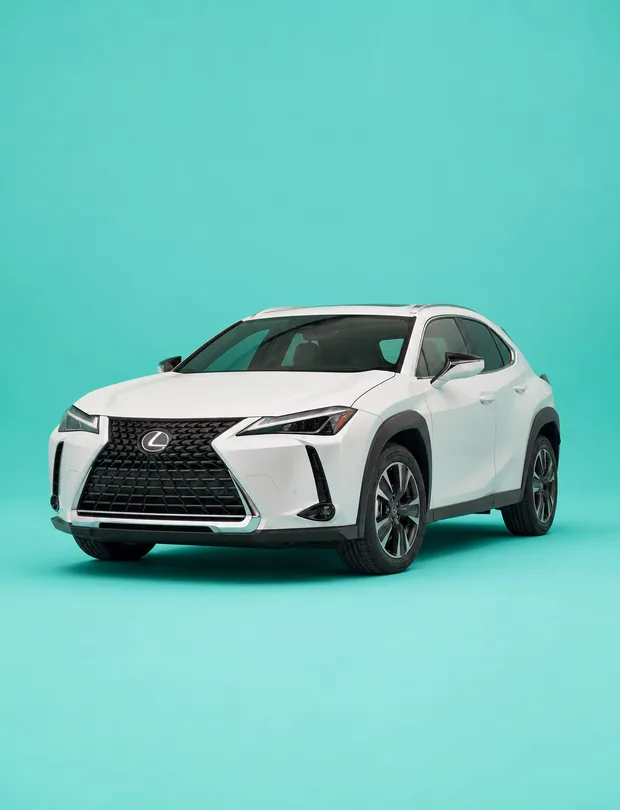
 The UX (AA10 platform, launched 2019) is Lexus's compact crossover and the smallest SUV the brand sells in New Zealand. It sits below the NX on price and footprint and cross-shops against the Audi Q3, BMW X1, Mercedes-Benz GLA, and Volvo XC40. The NZ lineup runs three drivetrains: the UX200 2.0 petrol (earlier NZ-new and JDM-import stock), the UX250h 2.0 hybrid (the volume NZ-new variant), and the UX 300e fully-electric (launched locally in 2021, refreshed with a larger 72.8 kWh battery in 2023). The UX is the typical first-Lexus finance application for younger professional buyers stepping out of a well-specified Golf, Mazda CX-30, or Audi Q2, and it's commonly used as a second-household-car alongside a larger NX or RX. NZ-new stock comes with the Lexus NZ 5-year factory warranty plus 3-year Encore servicing inclusions; the UX 300e carries the standard 8-year EV battery warranty on top.
Calculate repaymentsIndicative only. Not a quote or offer of credit.
Year by year
Typical NZ market prices and the weekly cost of financing each. All figures assume 7% over 5 years with no deposit. Indicative only; open the full calculator to pre-set your own rate and term.
2019-2020 used (launch)
$34,000Early NZ-new UX200 petrol and UX250h hybrid. Typical 50,000 to 100,000 km. UX 300e not yet on the NZ market.
Weekly
$155.36
Monthly
$673.24
2021-2022 used
$48,000UX 300e launched in NZ on 54.3 kWh battery. UX250h the volume variant through NZ-new stock; UX200 petrol thinning out.
Weekly
$219.34
Monthly
$950.46
2023 used
$62,000UX 300e updated to 72.8 kWh battery with material real-world range improvement. UX250h facelift with updated infotainment.
Weekly
$283.31
Monthly
$1,227.67
2024+ new/nearly-new
$78,000Current UX250h and UX 300e on Lexus NZ dealer floors. F Sport and Limited trims dominate new orders. Encore servicing inclusions standard.
Weekly
$356.42
Monthly
$1,544.49
Who this suits
Financing notes
At a $48,000 used UX250h on a five-year term at 7.6% (indicative), the weekly repayment sits at roughly $223, or $968 a month. A new UX250h F Sport near $78,000 on the same settings lifts the weekly to around $362, and a UX 300e at $85,000 on a dedicated EV loan tier (typically 0.25 to 0.75 percentage points below the standard secured rate on most NZ lender panels) runs near $389 a week. A 20% deposit on the $78,000 UX250h drops the weekly to around $290. NZ-new UX residuals have held up comfortably across the four-year window on indicative NZ used-market trends, with the UX 300e sitting slightly softer because EV residual data on compact premium models is still maturing in the NZ market.
Model-specific questions
On a $48,000 used UX250h at 7.6% indicative over five years with no deposit, the weekly sits at roughly $223. A new UX250h F Sport at $78,000 on the same settings lands near $362 a week. A UX 300e at $85,000 on an EV loan tier at 7.1% indicative over five years runs near $389 a week. A 20% deposit on the $78,000 UX drops the weekly to around $290. These figures are illustrative only; actual rates depend on the lender's assessment.
The UX250h hybrid is the volume NZ-new finance application, sharing the core Toyota Hybrid System drivetrain with Corolla Hybrid and RAV4 Hybrid and benefiting from the same deep NZ reliability and residual dataset. The UX 300e EV sits at a smaller but growing share of new applications, supported by a dedicated EV loan tier on most NZ lender panels. The UX200 petrol is now largely a used-market finance story, typically on earlier NZ-new and JDM-import stock.
Loan amounts on matched-spec UX250h, Q3 35 TFSI, and X1 sDrive18i track closely in both new and used markets, and the indicative rate applied by most NZ lenders is similar across the three on a comparable applicant profile. The UX250h typically sit below the Q3 and X1 petrol equivalents on fuel and scheduled servicing across a five-year term because of the hybrid drivetrain and Toyota-group parts supply. Buyers who prioritise driving character commonly cross-shop X1 and Q3; buyers who prioritise running-cost predictability commonly favour UX250h.
Yes. Most NZ secured-car-loan providers apply a dedicated EV tier that typically sits 0.25 to 0.75 percentage points below the standard secured rate on a fully-electric UX 300e. The tier isn't universal; a small number of lenders price the UX 300e on the same rate as the UX250h hybrid. A broker broker comparison will flag whichever panel lender is currently running the tightest EV rate on the specific VIN and deposit.
The UX 300e carries the Lexus NZ 8-year or 160,000 km EV battery warranty on NZ-new cars, which typically covers the full term of a standard five-year loan and well into a second ownership cycle. The 72.8 kWh battery introduced on the 2023 refresh lifts real-world range materially over the earlier 54.3 kWh car, which supports lender residual confidence on post-2023 examples. Ex-Japan import UX 300e examples don't carry Lexus NZ battery warranty and loan terms run shorter.
Yes. A chattel mortgage through the company is the common structure for owner-operators and small professional-services firms using a UX250h or UX 300e as an executive-commuter vehicle. Finance interest is generally deductible against business income where the UX is used primarily for business, and GST is typically claimable in the next GST return for GST-registered buyers, both subject to the accountant's confirmation. FBT on private use is the standard consideration where the vehicle sits with a single employee.
Five years is the common default on NZ-new UX250h and UX 300e loans, aligned with the Lexus NZ 5-year factory warranty. Three and four-year terms are common on used UX stock and on younger applicants managing a first premium-vehicle loan. Seven-year terms are available on new UX through some lenders but grow total interest meaningfully; on our calculator, a $75,000 loan at 7.6% indicative costs around $8,700 more in interest over seven years than five.
Yes, materially across the first three years. The Lexus NZ Encore programme covers scheduled servicing, WoF, and roadside assistance for the first 3 years or 45,000 km (current policy at 2026; confirm with Lexus NZ on the specific VIN), which removes the scheduled-servicing line from the ownership budget across that window. For finance purposes this keeps the total cost-of-ownership picture predictable over the front half of a five-year loan. Encore doesn't apply to ex-Japan import UX examples.
Our finance partner compares multiple NZ lenders. Calculator inputs travel through to the application, and the partner returns a formal estimate after the lender's credit assessment.
Disclaimer
A car loan runs for years, and the repayment comes out of the same pay that covers everything else. This site exists to show you that weekly number before you sign anything. The payment that catches people out is the one that's fine on a good week and tight on a bad one.
Carfinance.org.nz receives a commission from Simplify when a visitor applies through this site and their application is approved. We refer every visitor to the same partner because they compare multiple New Zealand lenders on the applicant's behalf, so the referral is not driven by a sponsored deal. Simplify sets its own terms and fees and discloses them directly; anything you agree to happens on their side, not ours. Every figure shown on this site is a modelled estimate based on the inputs entered; the actual rate, fees, and repayments are set by the lender after assessing the applicant's circumstances and its own credit decision. Carfinance.org.nz is a calculator and information tool. We are not a lender, not a broker, and not a registered financial adviser. Any decision about whether a specific loan suits a specific situation is best made after talking with the lender, and for amounts that materially affect the household, with a registered financial adviser.
Connecting you with a trusted NZ finance partner
One moment while we hand you over securely. Nothing was collected on our side.