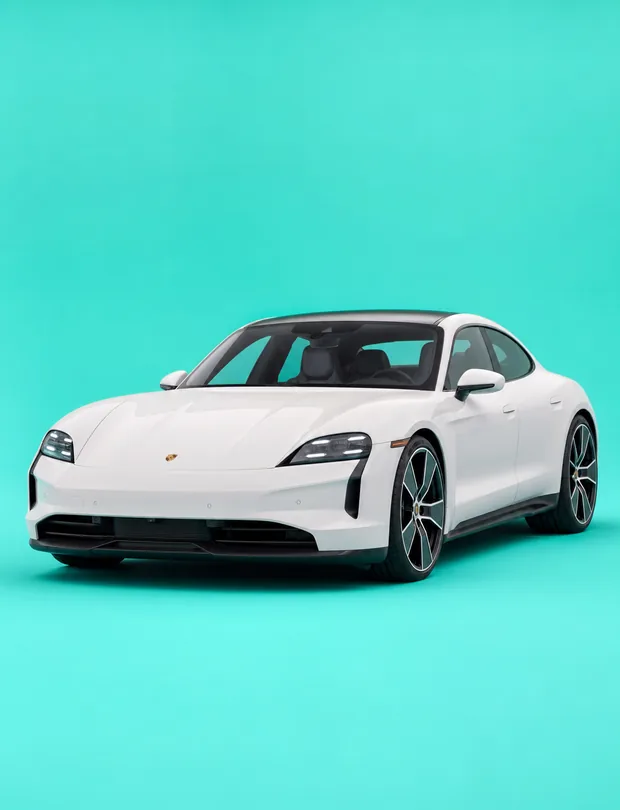
On a $160,000 used 2022 Taycan 4S at an indicative 7.8% EV tier rate over five years with no deposit, the weekly sits at roughly $741. A new $230,000 facelifted Turbo on the same settings lands near $1,066 a week. A $320,000 Turbo GT runs near $1,483 a week. A 25% deposit on the $230,000 car drops the weekly to around $800. These figures are illustrative only; actual rates depend on the lender's credit assessment and any active Porsche Financial Services campaign.
Most NZ lenders with an EV tier apply it to Taycan on the same terms as a Model S or Ioniq 5, typically pricing indicatively below their standard premium-secured-car rate from what we see. Specialist asset-finance lenders (UDC, Finance Guys) sometimes price Taycan outside the EV tier and inside a premium sports car tier because the purchase price is above typical EV-tier ceilings. Getting both tiers quoted on the same deposit and term is the common way to see which applies to a specific Taycan and applicant profile.
A Porsche NZ dealer can generate a PIWIS battery diagnostic report showing state of health and individual cell balance on a Taycan. Most premium NZ lenders treat that report as standard pre-purchase documentation on a used Taycan, similar to how a Leaf battery-health report is treated at the other end of the EV market. Reports cost in the $200 to $400 range through a Porsche dealer. An import Taycan commonly requires this report before funding draws down because lender residual data on specific UK or JDM trim combinations is thinner than on NZ-new stock.
PFS runs subvented rates on specific Taycan campaigns through Giltrap Porsche and Archibald & Shorter, particularly around quarter-end and against older model-year Taycan inventory before a facelift. When subvention is live the dealer rate can clear an independent broker quote because the rate is partially funded by Porsche rather than the lender. When no campaign is active the default PFS rate is a standard premium-secured rate and a broker quote typically matches within half a percentage point. Getting the specific campaign rate, residual, deposit, and term in writing is how the offer is commonly evaluated.
Taycan is subject to the light EV Road User Charge of $76 per 1,000 km since 1 April 2024, in addition to registration and WoF. On 12,000 km a year that adds around $910 annually, or roughly $17.50 a week. RUC balances transfer with the vehicle at sale, so an outstanding RUC balance is commonly checked on a Carjam report before settlement and cleared as part of the handover. On a Cross Turismo used for Auckland-to-Queenstown touring the RUC line can run materially higher if the annual distance pushes into the 20,000 km range.
Yes, where business use can be documented. A chattel mortgage is the common structure for closely-held companies, trusts, and sole traders; the GST on the purchase price is typically claimable in the next GST return where the business is GST-registered and the Taycan qualifies, subject to the accountant's confirmation. Finance interest is generally deductible against business income in proportion to business use, also subject to accountant confirmation. Fringe-benefit tax applies where the Taycan is also available for private use and materially affects the overall cost picture; operating-lease and finance-lease structures are alternatives commonly considered at this price level.
UK-import Taycan is right-hand drive and mechanically identical to NZ-new stock, which most NZ premium-car lenders treat on similar terms once entry compliance is complete and a PIWIS battery-health report is produced. A rate premium of 0.5 to 1 percentage points is typical on UK imports versus an equivalent NZ-new example. Japanese-import Taycan is rarer and commonly carries a slightly higher premium and shorter maximum term because JDM-spec trim combinations feed thinner NZ residual data. A specialist pre-purchase inspection covering 12V auxiliary battery and high-voltage system is commonly treated as non-optional on any imported Taycan.
Taycan and e-tron GT share the 800V J1 platform, so loan amounts on matched-spec 4S and RS e-tron GT track closely in NZ and the rate applied by most NZ premium-car lenders is similar on the two. Tesla Model S sits in a similar price bracket but cross-references a different residual dataset and is often priced at a marginally softer rate at EV-specialist lenders because the used-Tesla pool is deeper. BMW i5 M60 is a newer entrant at a lower price point and sits in the premium-EV sedan bracket rather than the performance-EV bracket. Buyers who prioritise chassis feel and 800V charging speed commonly favour Taycan; buyers who prioritise total ownership-cost across the term commonly cross-shop Model S or i5.