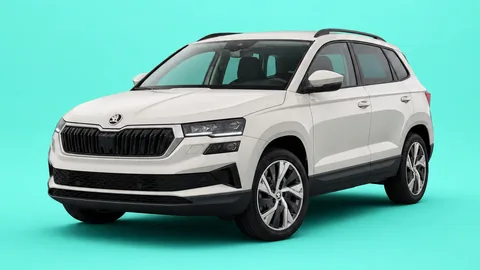
Dealer finance through Skoda's branded finance programme (via European Financial Services) typically beats broker rates. Its promotional pricing is genuinely subvented and isn't available through independent brokers, so a campaign rate there can sit below anything a broker can reach. Most buyers get a broker quote to compare, but the dealer rate often wins on current stock.
Not very much in practice. Both brands sit under EMD locally and finance through the same partner-lender pool at similar rates. Skoda sticker pricing typically runs 5 to 12% below a like-spec VW sibling, so the weekly can land lower on a Skoda even before any finance difference. On residuals, VW holds slightly stronger in the NZ used market because brand recognition is deeper, but the platform sharing keeps the gap narrow.
Skoda NZ operates a branded Skoda Finance programme via European Financial Services (a division of UDC Finance) with manufacturer-backed subvention. Standing rates are 7.95% p.a., and promotional rates run as low as 1.9% p.a. across the range. This isn't a third-party broker arrangement but a genuine manufacturer-aligned finance product.
10 to 20% is the common range. On a $35,000 Karoq that's $3,500 to $7,000; on a $55,000 Kodiaq that is $5,500 to $11,000. EMD-Skoda subvented deals on new stock often require 20 to 30% to unlock the promoted rate. A deposit typically drops the offered rate by a small margin and protects against early negative equity as the Skoda depreciates through its first 12 to 18 months.
Usually yes on the Octavia, which has been in NZ through multiple generations, and with more caution on Kodiaq, which has a shorter NZ history (2017 onward). Most NZ secured-car-loan products cap vehicle age at 12 to 15 years at loan-end, so a 10-year-old Octavia clears a 3-year term but often not a 5-year one. Expect a rate 1 to 2 percentage points above a 3-year-old equivalent.
Yes, in most cases. Most NZ lenders operate dedicated EV loan tiers at 0.5 to 1.5 percentage points below standard secured-car-loan rates, and the Skoda Enyaq (sharing the MEB platform with VW ID.4 and ID.5) typically qualifies. Availability varies by lender, and Enyaq volumes in NZ are smaller than the ID.4, so a broker will confirm whether the EV tier applies at application.
If the trade-in value exceeds your outstanding loan balance (positive equity, common on current-generation Octavia and Kodiaq), the dealer pays out the old loan and surplus applies to the next purchase. If the value is below the balance (negative equity), the shortfall rolls into your new loan. Strong VW Group platform resale keeps Skoda negative-equity risk moderate on standard 5-year terms.
The 5-year / 150,000 km factory warranty on new Skoda stock stays in force regardless of which lender funds the loan and covers most of a standard 4 or 5 year secured-car-loan term. That makes dealer-bundled mechanical breakdown insurance at signing duplicative during the warranty period, which keeps the loan amount lower and typically saves $400 to $600 of interest across a 5-year term.
Yes, most NZ lenders allow it but will scrutinise affordability more closely. If you owe $5,000 on your current car and are buying a $40,000 Karoq, the new loan becomes $45,000 before trade-in and deposit. Starting a Skoda loan underwater delays building equity, though Skoda resale tracking VW Group peers keeps the underwater period shorter than on brands with softer residuals.
The finance structure is the same but the numbers diverge. A new Kodiaq ranges from around $60,000 on base trims to $95,000 on the RS, sitting in a larger underwriting band with slightly tighter loan-to-value expectations (often 85 to 90%) and more scrutiny on affordability than a $28,000 Octavia. Kodiaq applications often work cleanly under a 5-year term thanks to strong VW Group resale; Octavia applications work at 4 to 5 years across most variants.
All three finance through European-brand partner-lender product at broadly similar rates. Skoda and VW share EMD distribution, which means service-network overlap and similar residual modelling. Peugeot is distributed separately and has thinner NZ volume, which can produce marginally wider lender residual assumptions. Skoda typically buys in slightly cheaper than a like-spec VW; Peugeot sits in its own price band.
For a $55,000 used Kodiaq on a 5-year loan at around 8%, finance totals roughly $66,500 principal plus interest. Add insurance ($8,500 to $11,500), servicing and tyres ($9,500 to $13,000), and fuel ($12,000 to $15,500 at 14,000 km a year) for a rough all-in of $97,000 to $106,500 over 5 years, or around $385 a week. European-brand servicing runs a band above Japanese mainstream equivalents.