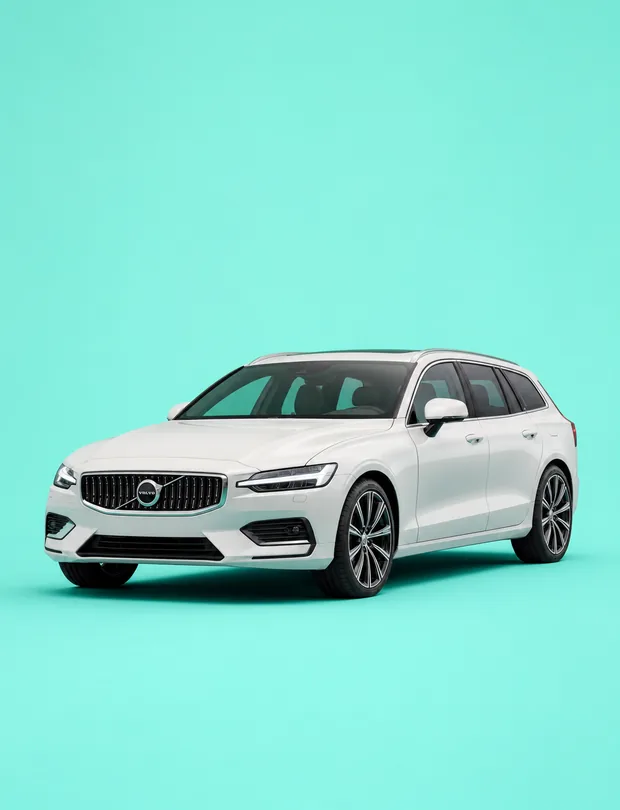
On a $44,000 mid-run third-gen V60 at 7.8% indicative over five years with no deposit, the weekly sits at roughly $206. A new B5 Ultra near $85,000 on the same settings runs near $397 a week. A T8 Recharge near $100,000 lands near $467 a week. A 20% deposit on the $85,000 car drops the weekly to around $317. These figures are illustrative only; actual rates depend on the lender's credit assessment and any active Volvo Car Financial Services campaign.
Generally no. The V60 Cross Country uses the same drivetrain family (B5 AWD on current stock) and carries the same new-car warranty umbrella as the standard V60, so lenders treat it as a variant of the same model rather than a separate nameplate. Purchase price sits a few thousand dollars higher than matched-spec standard V60 on AWD and raised-ride hardware; the weekly difference at 7.8% indicative over five years is modest. Residual data on Cross Country is thinner than on the mainstream V60 because volumes are lower, but the rate applied by most NZ lenders is the same on the same applicant profile.
Loan amounts on matched-spec V60 B5, 330i Touring, C300 Estate, and A4 Avant 45 TFSI track closely in the NZ used and new markets, and the rate applied by most NZ lenders is similar across the four on the same applicant profile. The V60 and the German three occupy the same narrow wagon segment in New Zealand, and all four carry thinner supply than their sedan siblings. Buyers who prioritise interior refinement and safety rating commonly favour V60; buyers who prioritise on-road dynamics and deeper parts availability commonly cross-shop the BMW, Mercedes, and Audi. The right choice depends on which matters more to a given household.
The T8 Recharge carries a purchase premium of roughly $15,000 to $25,000 over a comparable B5 depending on spec and model year, and most NZ lenders place the T8 in a green-loan or lower-emissions tier at an indicative rate slightly below the standard premium-car rate. The PHEV Road User Charge of $38 per 1,000 km applies. Fuel spend typically falls materially where the daily commute is within the electric-only range (around 70 to 90 km on the current T8) and home charging is in place. Over a four to five year hold with disciplined charging, the T8 premium is often partly recovered, though the break-even is highly sensitive to actual charging behaviour and annual distance.
Volvo Cars NZ ships new V60 and V60 Cross Country with a five-year unlimited-kilometre factory warranty, which on a standard five-year loan means the warranty umbrella covers the full term. The practical implication is that lenders view the warranty-covered portion of the ownership cycle as lower-risk from a mechanical-breakdown standpoint, and mechanical-breakdown insurance is typically optional rather than mandatory on NZ-new applications. On older third-generation V60 examples outside the five-year window, MBI is commonly added to manage exposure to infotainment and PHEV component repair costs.
Yes, where business use can be documented. A chattel mortgage is the common structure for closely-held companies and sole traders; the GST on the purchase price is typically claimable in the next GST return where the business is GST-registered and the V60 qualifies, subject to the accountant's confirmation. Finance interest is generally deductible against business income in proportion to business use. Fringe-benefit tax applies where the V60 is available for private use and materially affects the overall cost picture. Operating-lease and finance-lease structures are alternatives commonly considered at this price point and are usually confirmed with the accountant before settlement rather than after.
Deposits in the 15 to 25% range are common on V60 loans. The loan size commonly runs $40,000 to $100,000, and lenders price residual-value exposure on a compact premium wagon at this size accordingly. A 20% deposit on an $85,000 new B5 Ultra reduces the weekly by roughly $79 on the calculator at 7.8% indicative over five years and removes several thousand dollars of total interest over the life of the loan. Trade-in equity from a previous V60, 3 Series Touring, C-Class Estate, or comparable premium wagon commonly supplies most or all of the deposit.
Four to five years is the typical range on V60 loans, matching the S60 sedan pattern. Five years is the common default on personal-use applications where the ownership horizon is longer; four-year terms are common where the buyer intends to align the loan with Volvo's five-year factory warranty. Seven-year terms are offered by some lenders on new V60 but add meaningful total interest and, on the thinner wagon-segment trade-in profile, can make negative equity in the middle years more likely if the car is traded early. Used wagon supply in New Zealand is historically tighter than sedan supply, which in indicative NZ used-market observation tends to support slightly firmer private-sale pricing at the three to five year mark.