






Skip to content
Carfinance.org.nz
Ferrari logo Premium brand

Ferrari car finance calculator

Published 23 April 2026 · Last reviewed 23 April 2026 · Disclaimer

An ultra-low-volume exotic marque on New Zealand finance books, distributed through Continental Cars in Auckland and sold on a strict allocation basis that keeps new-car supply tight relative to demand. Ferrari sits near the tail of the Carjam NZ fleet register by volume but consistently at the top of the average-ticket-price table, and lender treatment is specialist asset finance with meaningful collector-market overlay rather than standard secured-car pricing. Loan sizes typically run from around $180,000 on a used California T through to roughly $1,100,000 on a new SF90 XX or a Purosangue delivered on current-window allocation. Buyer activity is heavily weighted toward the used market because new-car allocation is closed to most first-time Ferrari buyers.

Your estimated repayment

Weekly

Disclaimer

$1,462/week

$2,924 /fortnight $6,336 /month
$320,000
$0
7.00% p.a.
5 years

We are not a finance company. Indicative only. Not a quote or offer of credit. Actual rates, fees, and repayments depend on your circumstances and the lender's decision.

Popular Ferrari models

The Ferrari range, by typical price.

Median used-car prices in NZ, 2026 market. Weekly figures assume 7% over 5 years with no deposit. Click a model for a dedicated calculator and FAQs.

Ferrari

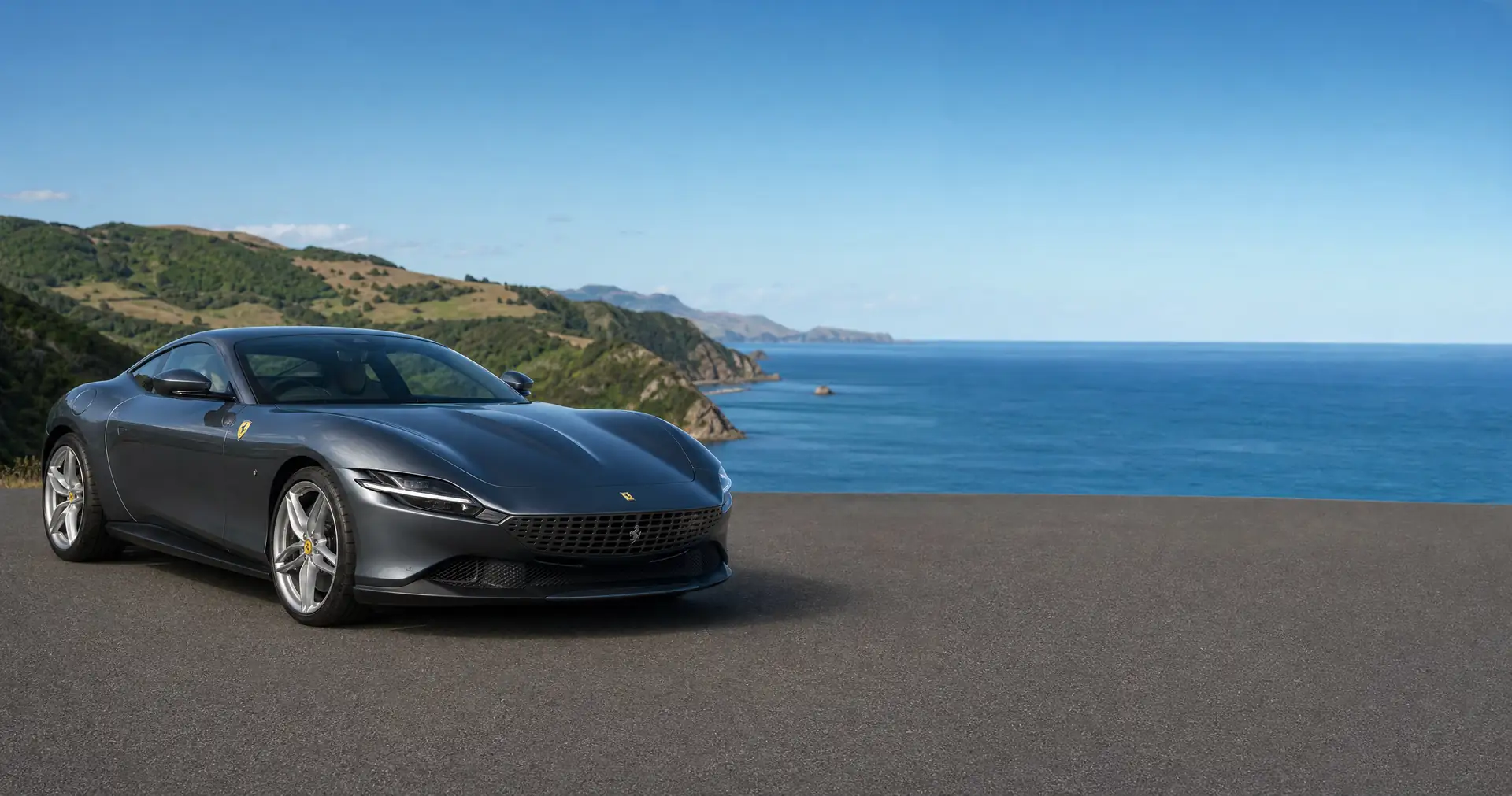
Roma

Ferrari's front-engined twin-turbo V8 grand tourer, the most livable new Ferrari on NZ roads.

$400,000

From

$1,828/week

Dedicated Roma page →

Ferrari

296 GTB

Ferrari's 3.0L V6 plug-in hybrid mid-engined supercar, replacing the 488 line.

$490,000

From

$2,239/week

Dedicated 296 GTB page →

Ferrari

Purosangue

Ferrari's four-door V12 GT, cross-shopped against Rolls-Royce Cullinan and Bentley Bentayga.

$750,000

From

$3,427/week

Ferrari

SF90 Stradale

Ferrari's plug-in hybrid V8 flagship supercar.

$650,000

From

$2,970/week

Why this brand finances well

What lenders look for in a Ferrari.

  • Ferrari residuals on specific limited-allocation cars (488 Pista, F12tdf, 812 Competizione, SF90 XX) behave unlike any other mass-production premium marque, regularly appreciating through the loan term on well-specified examples, which gives specialist asset-finance lenders and private banks unusual confidence on loan-to-value across 3 to 4 year terms.
  • Continental Cars handles Ferrari NZ distribution with established service, parts, and Ferrari Approved Pre-Owned infrastructure, so residual documentation and NZ-specific service history run through a known authorised network rather than a generalist premium dealer.
  • The Purosangue and SF90 widen the underwriting conversation beyond pure collector-supercar profiles because both have genuine daily-use credentials, which opens the business-structured finance path for buyers who would not buy a two-seater Ferrari on a chattel mortgage.
  • Limited-allocation new Ferrari stock is rationed by Ferrari globally, which means new-car pricing holds firmly and existing Ferrari ownership is often required before a new-car allocation is offered, supporting used-market residuals and lender confidence in equity cushions.
  • The 296 GTB, 296 GTS, SF90 Stradale, and SF90 XX qualify for PHEV tier pricing at some NZ specialist lenders on eligible applications, which can sit 0.25 to 0.75 percentage points below standard specialist-asset rates depending on the lender.

Buyer notes

Where to get the best Ferrari rate.

A standard consumer secured-car loan is almost never the right instrument on a Ferrari. On a new allocation through Continental Cars, the conversation runs in parallel across a specialist asset-finance lender, a private-banking relationship where one exists, and the accountant on whether a chattel mortgage or a cash purchase delivers the best after-tax outcome. On a used Ferrari (the bulk of NZ finance activity), start with a Ferrari-specialist pre-purchase inspection and a Ferrari Classiche certification review for historic cars before any finance quote becomes meaningful.

No sign-up on our site. Our finance partner compares NZ lenders and returns a formal estimate after the lender's credit assessment.

New vs used

Financing a new Ferrari vs a used one.

The Ferrari finance path in New Zealand runs along channel lines rather than the typical new-versus-used age split. Continental Cars allocation-controlled new stock behaves differently from Ferrari Approved Pre-Owned used stock, which behaves differently again from UK-imported right-hand-drive cars and private-sale collector transactions.

Path 1

New Ferrari (Continental Cars allocation)

Allocation comes first, finance second

  • Ferrari globally rations new-car allocation and typically prioritises existing Ferrari owners, which means first-time buyers often wait multiple years or step through a Ferrari Approved Pre-Owned purchase first to establish an ownership record.
  • Ferrari Financial Services does not operate as a locally-subvented captive in NZ; finance on new allocation runs through specialist asset-finance lenders and private banking rather than a manufacturer-subsidised rate.
  • Deposits of 30 to 40% are typical on new Ferrari applications, and the drive-away price is effectively non-negotiable because the car is allocation-controlled.
  • For a Purosangue or SF90 with a genuine business-use case, a chattel mortgage through a specialist lender almost always beats a consumer secured-car structure on after-tax cost across a 3 to 4 year term.

Verdict

New Ferrari supply is allocation-driven rather than open order, so securing a build slot through Continental Cars precedes any finance conversation. Once allocation is confirmed, price a specialist asset-finance quote against a private-banking relationship and get the accountant to model a chattel mortgage against cash on Purosangue or SF90 applications with a business-use case.

Path 2

Used Ferrari

Specialist inspection and provenance come before finance

  • Continental Cars Approved Pre-Owned stock carries dealer inspection, warranty top-up, and verified service history through the NZ network, which specialist lenders treat as substantially lower risk than private-sale or UK-imported equivalents.
  • UK-imported 458, 488, California, Portofino, and F12 stock regularly appears on the NZ market at prices $30,000 to $100,000 below Continental Cars Approved Pre-Owned equivalents, but HPI checks, accident history, and main-dealer service records drive the lender-approved rate on every import.
  • Older 360, F430, and 430 Scuderia cars often require specialist inspection focused on F1 gearbox condition, exhaust manifold cracking (on 360 and 430), and valve-guide wear before specialist-asset finance will fund.
  • Limited-allocation cars (458 Speciale, 488 Pista, F12tdf, 812 Competizione, SF90 XX) typically track global collector-market pricing and can appreciate through a 3 to 4 year loan on well-provenanced examples, which supports longer-term lending than standard exotic pricing implies.

Verdict

Start with a Ferrari-specialist pre-purchase inspection and a service-history review before any finance conversation. On historic cars, a Ferrari Classiche assessment materially affects both resale and lender confidence. Specialist asset-finance rates typically sit 0.5 to 1.5 percentage points above Continental Cars Approved Pre-Owned equivalents.

Rule of thumb

On any new Ferrari, secure the allocation first and structure the finance second. On any used Ferrari, a Ferrari-specialist pre-purchase inspection (and Classiche certification on historic cars) comes before any rate conversation. Getting either sequence wrong usually costs more than the finance rate itself.

Total cost of ownership

What a Ferrari really costs beyond the finance line.

Running costs on a Ferrari sit at the top of the NZ premium envelope and the spread across the range is narrower than buyers expect because service, parts, and tyre pricing is Ferrari-specific rather than platform-specific. Factory warranty and Ferrari Power extended-warranty packages cushion the first several years; post-warranty ownership on older 458, 488, or California stock carries mechanical risk that belongs in the weekly cost picture from the outset.

  • Servicing and consumables

    Scheduled servicing on a Roma or Portofino M at Continental Cars runs roughly $3,500 to $7,000 per annual visit. 296 GTB and SF90 sit $4,000 to $8,500 because of hybrid-system attention. Major services (belts on older 458 and California, clutch on F1 gearbox cars) sit materially above the scheduled figure.

    $650 to $1,600 per month
  • Insurance (agreed value)

    Roma and Portofino M typically $9,500 to $14,000 on agreed-value cover. 296 GTB $12,000 to $18,000. SF90 Stradale $16,000 to $22,000. Limited variants (SF90 XX, 12Cilindri, collector 488 Pista, F12tdf) $18,000 to $28,000. Agreed-value cover is effectively mandatory for finance drawdown.

    $9,500 to $28,000 per year
  • Road User Charges (296 and SF90 plug-in hybrid)

    Reduced PHEV rate of $38 per 1,000 km applies on 296 GTB, 296 GTS, SF90 Stradale, and SF90 XX since April 2024. Roma, 12Cilindri, and Purosangue V12 remain outside the diesel or EV RUC bands.

    $38 per 1,000 km
  • Tyres

    Roma on 20-inch Pirelli P Zero F01 $6,500 to $8,500. 296 GTB and SF90 staggered 20-inch N-rated and Ferrari-homologated $8,500 to $10,500. Limited-allocation track-focused variants on Cup 2 compounds $9,500 to $11,500 with shorter replacement cycles under enthusiastic use.

    $6,500 to $11,500 per set
  • Fuel (98 octane required)

    Based on 5,000 to 10,000 km a year (typical Ferrari annual distance runs lower than a daily-driven premium). 98-octane premium is mandatory. Roma and Portofino M mid-range, V12 12Cilindri and Purosangue at the top, 296 GTB and SF90 lower when run largely in hybrid mode on short trips.

    $5,500 to $13,000 per year

Worth knowing

Roma vs 911 Turbo S at the same finance weekly

A $450,000 Ferrari Roma and a $370,000 Porsche 911 Turbo S can be matched on weekly repayment by adjusting deposit and term. Once Ferrari-scheduled servicing at Continental Cars, agreed-value insurance, and Ferrari-homologated tyre sets are layered in, the Roma typically runs $18,000 to $30,000 a year above the Turbo S in combined running cost. The Ferrari badge premium shows up in running cost more than in the sticker once the cars are matched on weekly.

Resale and equity

How Ferrari resale shapes your finance decision.

80 to 110%

value retained, 3-year-old limited allocation (488 Pista, SF90 XX, 812 Competizione)

55 to 70%

value retained, 3-year-old standard run cars (Roma, Portofino M)

55 to 60%

premium-brand market average

Ferrari residuals in New Zealand behave in two very distinct bands. Limited-allocation cars (488 Pista, F12tdf, 812 Competizione, SF90 XX, 296 Speciale once it arrives) routinely retain 80 to 110% of purchase price at three years and often appreciate above MSRP on well-specified, low-km examples because global collector demand persistently exceeds production allocation. Standard-run current cars (Roma, Portofino M, 296 GTB in non-Assetto Fiorano specification) depreciate more conventionally at 55 to 70% over the same span, sitting above the mainstream premium average but well below the limited-allocation tier. Purosangue is too new for settled residuals in NZ, though its status as Ferrari's first four-door GT and its globally-rationed allocation support very firm early retention.

For finance the practical implication is that term length should follow the variant rather than the brand. Limited-allocation applications often support 4 to 5 year terms without residual risk because the car holds or grows purchase value across the term. Standard-run Roma, Portofino M, and base-spec 296 GTB applications sit best at 3 to 4 years with a 30 to 40% deposit because the back half of a 5-year loan can see the loan balance catch up with market value on higher-kilometre cars. On Purosangue and SF90 XX, specialist lenders typically hold terms to 3 or 4 years on initial NZ deliveries while local residual data develops.

Match the term to the specific Ferrari. Limited allocation cars (Pista, Competizione, XX, tdf, Speciale) handle 4 to 5 year terms on firm residual support, often appreciating through the loan. Standard Roma, Portofino M, and base 296 GTB applications sit best at 3 to 4 years with a 30 to 40% deposit. Purosangue and first-wave SF90 XX applications are best kept to 3 to 4 years while the NZ-specific residual data matures across the first delivery cycle.

Things to avoid

Ferrari finance traps we flag honestly.

An opinionated list. The commercial side of this site has no incentive to tell you these things, so we do.

Consumer secured-car finance on a Ferrari used for business

A consumer loan ignores GST and deductibility. A $650,000 Purosangue through a chattel mortgage with an accountant typically delivers $50,000 to $90,000 in after-tax advantage across a 4-year term versus the same car on consumer finance. Engage the accountant before Continental Cars discussion starts.

Financing a UK-imported 488 or 458 without a Ferrari-specialist inspection

UK-sourced 458 and 488 stock can list $40,000 to $100,000 below Continental Cars Approved Pre-Owned equivalents, but exhaust manifold cracking (458), clutch condition on F1 gearboxes, and accident-repair disclosure drive residual. A $1,500 Ferrari-specialist inspection protects against a post-settlement fault that routinely runs into the tens of thousands.

Balloon residual deals on a new Purosangue that mature into refinance problems

Some specialist lenders structure new Purosangue and Roma deals with a 35 to 45% residual to keep weekly figures in sight. On a $700,000 Purosangue the balloon sits at $245,000 to $315,000 at year 4, and owners often refinance the residual at worse open-market rates rather than paying it cleanly.

Underinsuring a limited-allocation car (488 Pista, 812 Competizione, SF90 XX)

Limited-allocation Ferrari cars require agreed-value cover through Star Insure, Vero Specialist Vehicles, or a classic-car underwriter. Insuring on market value rather than agreed value can leave a total-loss payout $150,000 to $500,000 below the loan balance on a limited variant. Agreed-value policy in place before the loan draws down is a lender precondition at this level.

Assuming a Ferrari Classiche certification is optional on historic cars

On pre-2000 and selected limited-production Ferrari cars, Ferrari Classiche certification materially affects both resale and specialist-lender confidence. Skipping the Classiche review to save the fee (typically a few thousand pounds or euros) often costs multiples of that figure at resale or refinance time. Budget Classiche assessment into any historic Ferrari finance plan.

Drivetrain economics

Hybrid vs petrol vs EV on a Ferrari.

Ferrari's current NZ drivetrain mix runs twin-turbo V8 petrol on the Roma and Portofino M, plug-in hybrid V6 on the 296 GTB and 296 GTS, plug-in hybrid V8 on the SF90 Stradale and SF90 XX, and naturally-aspirated V12 on the 12Cilindri and Purosangue. Rate differences across drivetrains are secondary at this price level; the PHEV tier eligibility and Road User Charges treatment are where finance-economics differences matter most.

Petrol V8 and V12 (Roma, Portofino M, 12Cilindri, Purosangue V12)

The volume drivetrains on NZ Ferrari finance; 98-octane and agreed-value insurance non-negotiable

  • 98-octane premium is required on every current petrol Ferrari; fuel spend is non-trivial on V12 12Cilindri and Purosangue applications driven meaningfully.
  • Financed at the specialist asset-finance rate with no drivetrain premium or discount at most NZ lenders.
  • Roma and Portofino M are the volume drivetrains on used-market NZ Ferrari finance applications through the used and UK-import channels.
  • 12Cilindri and Purosangue V12 applications carry the highest running-cost envelope within the current Ferrari lineup despite sitting below limited-allocation track variants on insurance.

Plug-in hybrid V6 and V8 (296 GTB, 296 GTS, SF90 Stradale, SF90 XX)

PHEV tier available at some specialist lenders; reduced RUC at $38 per 1,000 km

  • Reduced PHEV Road User Charges of $38 per 1,000 km apply since April 2024, roughly half the full EV rate.
  • Some NZ specialist lenders extend a PHEV tier discount of 0.25 to 0.75 percentage points on 296 and SF90 applications relative to equivalent V8 or V12 pricing.
  • 296 GTB electric-only range of roughly 25 km (NEDC figure; NZ real-world typically lower) makes urban use on battery alone feasible for short trips around Auckland, Wellington, and Queenstown.
  • Scheduled servicing sits above Roma and Portofino M on both 296 and SF90 because the hybrid system needs dedicated attention alongside the combustion drivetrain.

Break-even heuristic

Practical heuristic on Ferrari drivetrains: Ferrari annual distance typically runs lower than a daily-driven premium car (often 4,000 to 10,000 km a year), so PHEV fuel-saving calculations do not work on a typical usage pattern. The PHEV case on a 296 or SF90 is better framed around Road User Charges relief, potential specialist-lender PHEV tier pricing, and the performance-supplementing nature of the electric boost rather than a pure fuel-cost payback model.

Japanese imports

Financing an imported Ferrari.

Ferrari supply in New Zealand runs through Continental Cars as the authorised NZ-new and Approved Pre-Owned channel, with a substantial and persistent flow of UK-imported right-hand-drive stock on 458, 488, California, Portofino, F12, and selected 599 cars, and a thinner pool of European-sourced right-hand-drive cars. Finance treatment varies materially across channels and specialist-lender appetite for UK-import stock differs from the mainstream premium conversation.

01

UK-import 458, 488, California, and Portofino provenance

A meaningful share of the NZ used Ferrari market is UK-sourced, and specialist-lender comfort depends on the completeness of the UK service history (Ferrari main-dealer stamps, HPI check, MOT record, accident history), NZ entry compliance documentation, and an independent pre-purchase inspection through a Ferrari specialist. A well-documented UK import on Ferrari main-dealer history typically finances at the same rate as a Continental Cars Approved equivalent. A thin-history UK car or one with recorded accident repair often attracts a 0.5 to 1.5 percentage point premium and a shorter maximum term.

02

Older F1-gearbox cars and pre-2010 stock

F1 single-clutch gearbox cars (360 Modena and Spider, F430, 430 Scuderia, 599, California early) carry clutch-replacement intervals of roughly 20,000 to 40,000 km and cost $8,000 to $15,000 per clutch at Continental Cars. Specialist lenders typically require a specialist inspection covering clutch-wear percentage, gearbox pump condition, and exhaust manifold status before funding draws down on any pre-2010 F1-gearbox car.

03

Self-importing a Ferrari from the UK or Europe

Most NZ specialist lenders will only fund a Ferrari that is on NZ soil, compliance-certified, and registered. If the buyer is self-importing a 488 or F12 directly, plan to self-fund the purchase, shipping, and NZ compliance process (typically $30,000 to $70,000 in total costs on top of the car price), then refinance against the car once it is NZ-registered and has a verified market value from a registered valuer. Self-imports can also miss Ferrari NZ factory-warranty top-up that Continental Cars Approved stock typically carries.

Case study

Worked example: financing a 2022 Ferrari Roma through specialist asset finance

The buyer

Auckland-based property developer, age 49, strong credit, approximately $950,000 annual company profit through a property investment company, adding a Ferrari Roma as a weekend and limited-business-use vehicle alongside an existing Range Rover Autobiography daily.

The scenario

Purchasing a 2022 Ferrari Roma NZ-new from Continental Cars Auckland Approved Pre-Owned for $440,000. No trade-in; the Range Rover continues as the daily. Chattel mortgage structured through a specialist asset-finance lender to retain the Roma on the company balance sheet on a 40% business-use apportionment (client-entertainment, property-viewing, and director travel usage), with the 60% personal-use portion handled via fringe-benefit-tax treatment through the company.

The outcome

Monthly company cash-flow impact is roughly $7,765 before running costs, which sits within the company's director-vehicle budget alongside the Range Rover daily.

The $57,391 of GST inside the $440,000 purchase price is reclaimed in the next company GST return subject to the 40% business-use apportionment agreed with the accountant. The net GST benefit at 40% is approximately $22,956.

Finance interest and diminishing-value depreciation are deductible against company income at 40% business use across the four-year term, with the fringe-benefit-tax treatment on the 60% personal-use portion handled through the company's regular FBT returns.

The Roma remains under Ferrari NZ factory warranty and Ferrari Power extended coverage arranged through Continental Cars across the full loan term, which keeps mechanical-breakdown risk off the company P&L and supports residual at resale.

At year 4 the Roma is expected to sit around $280,000 to $330,000 on the NZ used market based on observed Roma residuals, which track firmer than mainstream premium equivalents on well-provenanced examples. The loan is fully repaid, the Roma is owned clean on the company balance sheet, and the decision to retain, trade, or upgrade to a 296 GTB or 12Cilindri runs as a straightforward capital and tax conversation rather than a finance one.

Illustrative example. Not a promise of approval or rate. Your circumstances and the lender's own credit decision will determine your actual outcome.

Affordability check

What can I afford on my income?

A rough sanity check. We assume repayments should sit under 10% of your take-home pay, with a 5-year term at 7%.

Not an affordability assessment. Real lender decisions consider all your debts, expenses, and history.

$70,000
$20k $250k

Indicative safe loan

$30,000

At ~$135/week

Stretch maximum

$45,000

Only with no other debts

Apply this to the calculator

Common questions

Ferrari finance FAQ.

Does Ferrari Financial Services operate as a subvented captive in New Zealand?

No, not in the way Audi Financial Services or BMW Financial Services run locally. Ferrari finance in NZ runs through specialist asset-finance lenders, private-banking relationships, and occasional Ferrari-administered European programs rather than a locally subvented captive book. The effective path for most buyers is to price a specialist asset-finance quote alongside a private-banking relationship and have the accountant review a chattel mortgage against a cash purchase where the car touches a business or trust.

Why is new Ferrari allocation so difficult to secure in New Zealand?

Ferrari globally rations new-car production to keep demand consistently above supply, and allocation is prioritised to customers with an existing ownership history through the authorised dealer network. Continental Cars, as the NZ authorised dealer, receives a small NZ share of each model's global allocation and distributes build slots against that constraint. First-time Ferrari buyers often step through an Approved Pre-Owned purchase first to establish a record before a new-car allocation becomes available.

Can I finance a UK-imported Ferrari 458, 488, California, or Portofino?

Yes, most NZ specialist asset-finance lenders fund UK-imported Ferrari stock provided the car has cleared NZ entry compliance, has documented UK Ferrari main-dealer service history, and passes a Ferrari-specialist pre-purchase inspection. A well-documented UK import typically attracts the same rate as a Continental Cars Approved equivalent. A thin-history or previously-repaired UK car often attracts a 0.5 to 1.5 percentage point premium and a shorter maximum loan term.

How much deposit is typical when financing a Ferrari in New Zealand?

30 to 40% is common on Ferrari applications, materially higher than the 10 to 20% mainstream benchmark. On a $450,000 Roma that is $135,000 to $180,000. Limited-allocation cars (488 Pista, SF90 XX, 12Cilindri allocation) often require 40 to 50% deposit because absolute loan exposure is larger and agreed-value cover and Classiche-equivalent documentation shape the application before funds draw down.

Is agreed-value insurance required on Ferrari finance?

Effectively yes on every application. Specialist asset-finance lenders, private banks, and the Continental Cars finance desk all expect agreed-value cover through Star Insure, Vero Specialist Vehicles, or a classic-car underwriter to be in place before funds advance. A total-loss payout below the loan balance on a $400,000-plus Ferrari is a material credit event that market-value insurance does not reliably protect against, particularly on limited-allocation variants where replacement values trade well above standard market-value definitions.

Can I finance a 360 Modena, F430, or 599 GTB that is over 15 years old?

Yes on a shortened term, provided the car passes a Ferrari-specialist pre-purchase inspection focused on F1 gearbox clutch-wear percentage, exhaust manifold cracking (360 and F430), and overall service history. Most NZ secured-car products cap vehicle age at 12 to 15 years at loan-end date, so a 2005 F430 often clears a 3-year term but fails a 5-year application. A specialist classic-vehicle lender such as Classic Vehicle Finance NZ is frequently a better fit than a mainstream specialist-asset product on F1-gearbox cars.

Do the 296 GTB and SF90 qualify for PHEV loan tiers in New Zealand?

Some NZ specialist lenders extend a PHEV tier discount of 0.25 to 0.75 percentage points on 296 and SF90 applications relative to equivalent V8 Roma or V12 12Cilindri pricing. Tier eligibility is not universal across specialist lenders and depends on loan amount, age, and specific lender product. Confirm tier treatment explicitly when the specialist lender quotes, because not every lender extends PHEV pricing to exotic-segment applications.

Does Ferrari Classiche certification matter for finance purposes?

On pre-2000 and selected limited-production Ferrari cars, Ferrari Classiche certification materially affects both resale and specialist-lender confidence because it confirms originality and provenance of key mechanical and body components. Specialist classic-vehicle lenders often price a Classiche-certified historic Ferrari tighter than an equivalent uncertified car, and the Classiche process is frequently required for agreed-value insurance on historic variants. Budget Classiche assessment into any historic Ferrari finance plan.

What happens to Ferrari finance if I trade the car in halfway through a loan?

If the trade-in value exceeds the outstanding loan balance (positive equity), the surplus applies to the next purchase. On limited-allocation Ferrari cars this is unusually common because residuals often track at or above the amortisation curve across 3 to 4 years, and on specific variants (488 Pista, SF90 XX, 812 Competizione) appreciation through the loan is plausible on well-kept low-km examples. On standard Roma, Portofino M, and base 296 GTB, negative equity in the back half of a 5-year loan is more likely, which is one reason specialist lenders often prefer 3 to 4 year terms.

Does Ferrari NZ factory warranty transfer to a used buyer?

Generally yes on any remaining balance of the 3-year factory warranty, and Ferrari Power extended-warranty coverage transfers where purchased, provided the car was sold NZ-new through Continental Cars and service records are intact through the authorised NZ service network (confirm specifics with Continental Cars for each vehicle). UK-imported Ferrari cars do not carry Ferrari NZ factory warranty, which shifts mechanical-breakdown risk fully to the buyer and shapes insurance and MBI decisions at signing.

What is the typical total cost of ownership for a financed Roma over 4 years?

For a $440,000 NZ-sold Roma on a 4-year specialist asset-finance chattel mortgage at an indicative 9.8%, finance costs total approximately $238,000 including interest. Add agreed-value insurance (around $44,000), Continental Cars scheduled servicing (around $22,000), 98-octane fuel at 7,000 km a year (around $18,000), and Ferrari-homologated tyre sets (around $18,000) for a rough all-in of $340,000 over 4 years, or roughly $1,635 a week before any business-use GST and deductibility adjustments. Running costs sit meaningfully above any mainstream premium equivalent at matched weekly repayment.

About this article
Published
23 April 2026
Last reviewed
23 April 2026

Methodology

Repayment figures on this page are calculated live from the inputs entered into the calculator using the standard amortised-loan formula. Indicative rates are drawn from observing publicly-advertised NZ specialist asset-finance pricing, private-banking secured-lending rates, and PHEV tier pricing across mainstream and specialist NZ lenders in the twelve months before the last review date. Ferrari model prices are observed from recent TradeMe and AutoTrader listings for NZ-sold and UK-imported Roma, Portofino M, 296 GTB, SF90, 812 Superfast, Purosangue, F12, 488, 458, California, and Portofino stock, cross-checked against Continental Cars Approved Pre-Owned and new-allocation pricing at review date. Warranty terms reference Ferrari NZ policy on vehicles sold through Continental Cars including Ferrari Power extended-warranty options. Running-cost figures are cross-checked against AA New Zealand, Consumer NZ, and NZTA Road User Charges guidance. We review annually or sooner if Continental Cars adjusts NZ pricing, the Ferrari NZ lineup moves, or PHEV RUC rules change.

Sources

Apply for Ferrari finance.

Our finance partner compares NZ lenders and returns a formal estimate after the lender's credit assessment. Calculator inputs travel through to the application so nothing gets re-typed.

All brands

Disclaimer

A car loan is a commitment that runs for years, and repayments come out of the same pay cheque as everything else. Before committing, it is worth modelling the weekly and monthly cost against the household budget, which is what this site is built to help with. Borrowing at a level that stays comfortable on a bad week, not a good one, is widely regarded as the safer frame.

Carfinance.org.nz earns a commission from a partner brand when a visitor applies through this site and their application is approved. That commission is paid by the partner, not the applicant, and it does not influence the rate the lender offers. We refer every visitor to the same partner because they compare multiple New Zealand lenders on the applicant's behalf, so the recommendation is not driven by a sponsored deal. Every figure shown on this site is a modelled estimate based on the inputs entered; the actual rate, fees, and repayments are set by the lender after assessing the applicant's circumstances and own credit decision. Carfinance.org.nz is a calculator and information tool. We are not a lender, not a broker, and not a registered financial adviser. Any decision about whether a specific loan suits a specific situation is best made after talking with the lender, and for amounts that materially affect the household, with a registered financial adviser.